
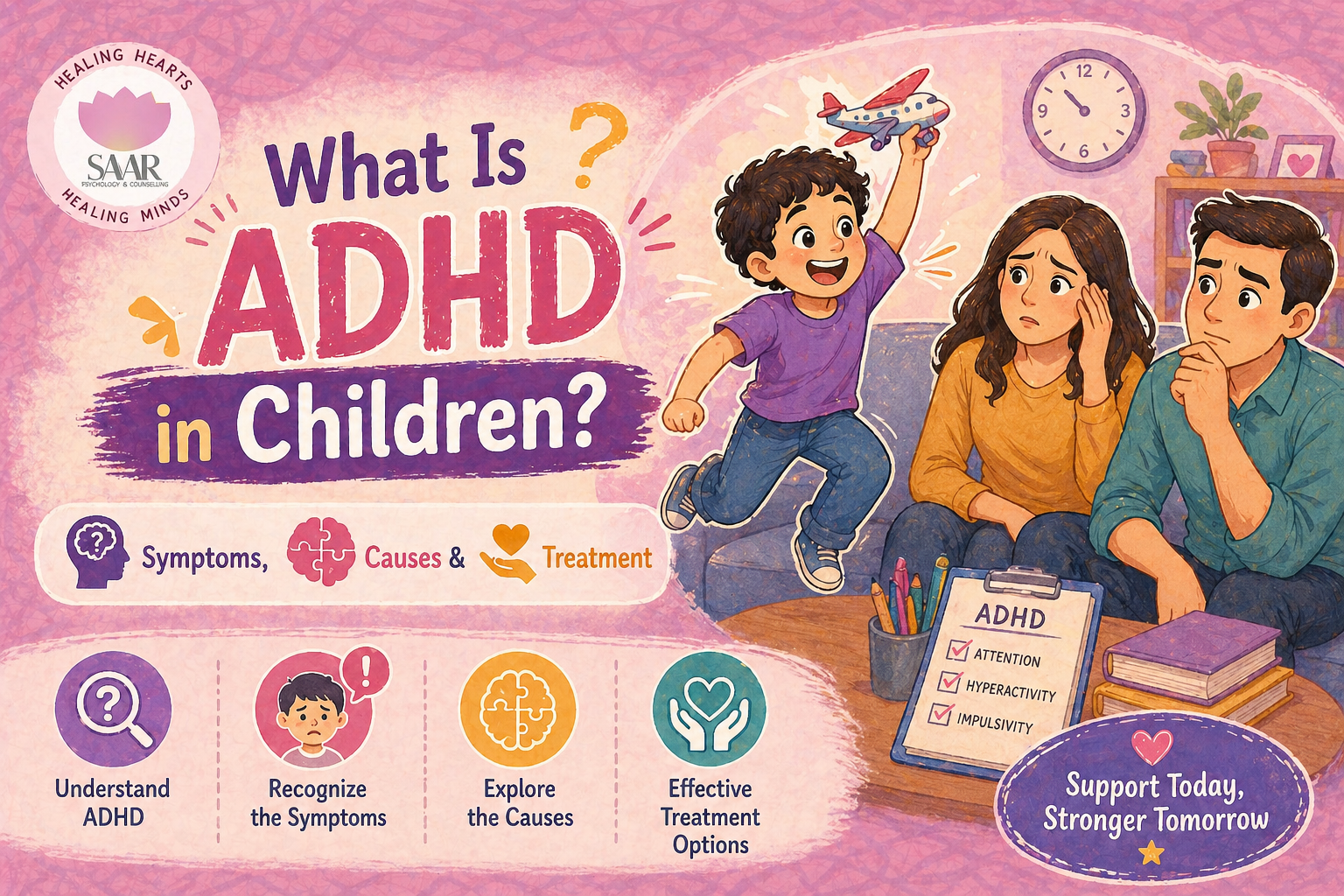
“Why Can’t My Child Sit Still or Focus?”
If you’ve ever wondered:
- Why does my child get distracted so easily?
- Why can’t my child sit still like others?
- Why are there constant complaints from school?
You’re not alone.
Many parents begin their journey with confusion, frustration, and often… blame.
And somewhere along the way, you may hear the word ADHD.
But what does it actually mean?
What Is ADHD in Children?
ADHD (Attention-Deficit/Hyperactivity Disorder) is a neurodevelopmental condition that affects how a child:
- Pays attention
- Controls impulses
- Regulates activity levels
It is not about intelligence.
It is not about “bad behavior.”
And it is definitely not caused by poor parenting.
Children with ADHD often want to focus and behave but struggle to do so consistently.
Common Symptoms of ADHD in Children
ADHD symptoms usually fall into three categories:
1️⃣ Inattention (Difficulty Focusing)
- Easily distracted
- Difficulty completing tasks
- Forgetfulness
- Not listening when spoken to
- Trouble following instructions
2️⃣ Hyperactivity (Excessive Movement)
- Constant fidgeting
- Difficulty sitting still
- Running or climbing excessively
- Talking excessively
3️⃣ Impulsivity (Acting Without Thinking)
- Interrupting others
- Difficulty waiting for turn
- Sudden emotional reactions
- Acting without considering consequences
👉 Not every active child has ADHD.
👉 The key is consistency, intensity, and impact on daily life.
What Causes ADHD in Children?
Many parents ask: “Why did this happen?”
ADHD is usually caused by a combination of factors:
- Brain development differences
- Genetic factors (family history)
- Neurochemical imbalance
- Environmental influences (in some cases)
It is important to understand:
👉 ADHD is not caused by parenting style
👉 It is not caused by “too much love” or “too little discipline”
Blame doesn’t help understanding does.
A Special Note for Mothers
Let’s pause here for a moment.
When a child shows ADHD-like behavior, the first person people question is usually the mother.
You may hear:
- “You’re not strict enough”
- “You’ve spoiled your child”
- “You don’t control him”
And slowly, guilt builds up.
But here’s the truth you need to hear:
👉 You did not cause ADHD
👉 You are not a bad mother
👉 You are a mother trying to understand your child in a confusing situation
And that deserves support, not judgement.
How Is ADHD Diagnosed?
ADHD is diagnosed by trained professionals based on:
- Behavior observation
- Parent and teacher feedback
- Developmental history
- Standard assessment tools
There is no single blood test or scan — it’s based on patterns over time.
If you suspect ADHD, early evaluation helps in better support.
Treatment Options for ADHD in Children
There is no “one-size-fits-all” solution.
Treatment usually involves a combination of:
1️⃣ Behavioral Therapy
- Helps children learn self-control
- Teaches emotional regulation
- Improves communication skills
2️⃣ Parent Training & Guidance
- Helps parents respond effectively
- Builds structured routines
- Reduces daily stress
3️⃣ School Support
- Classroom adjustments
- Teacher collaboration
- Learning strategies
4️⃣ Medication (If Recommended)
In some cases, doctors may suggest medication always under professional guidance.
Can ADHD Be Managed?
Yes, absolutely.
With the right support:
- Children improve focus
- Behavior becomes manageable
- Confidence increases
- Parent-child relationship improves
ADHD is not a limitation it just requires a different approach.
If you are:
- Confused about your child’s behavior
- Getting frequent school complaints
- Feeling overwhelmed or blamed
- Not sure whether it is ADHD or something else
You don’t have to figure this out alone.
Our one-to-one parenting counselling sessions help parents:
- Understand ADHD and child behavior
- Learn practical parenting strategies
- Handle hyperactivity and attention issues
- Reduce stress and confusion
👉 Book a session today clarity brings calm.
Your child is not difficult.
Your child is different — and that difference can be supported.
And you…
You are not alone in this journey.


