
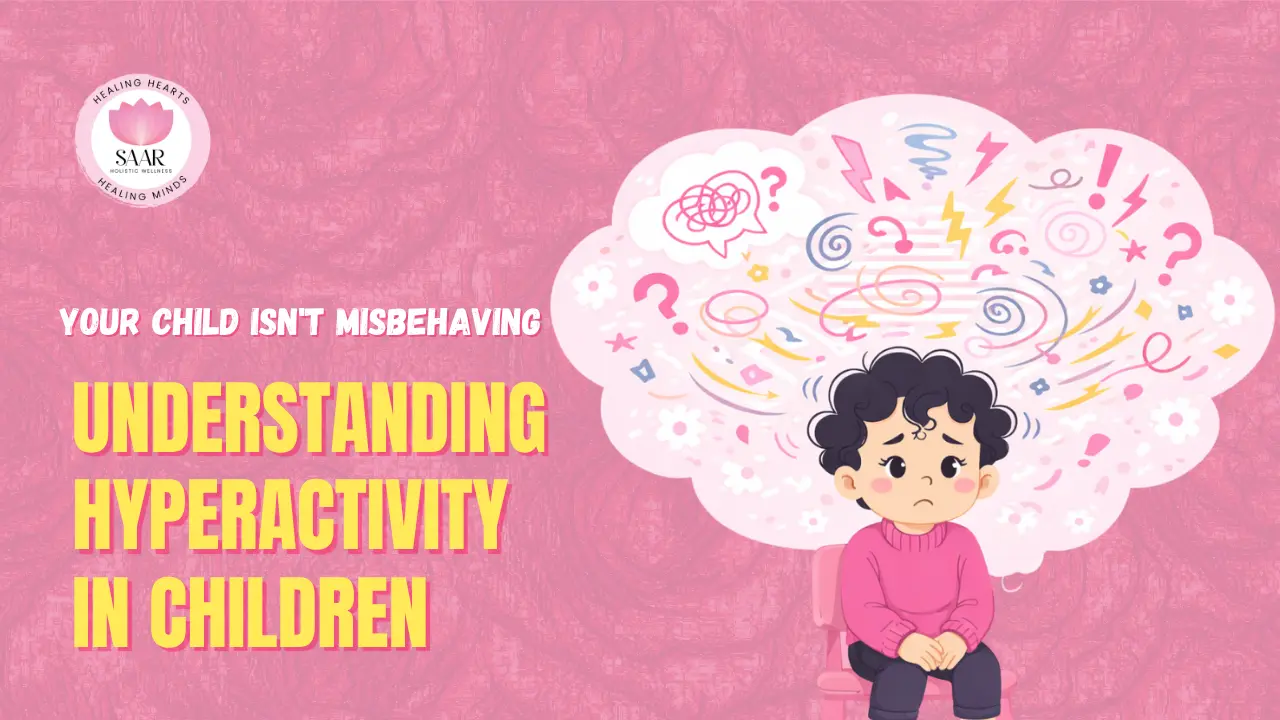
Globally, an estimated 8% of children and adolescents live with ADHD and millions more show hyperactive tendencies without a formal diagnosis. (Source: ScienceDirect Umbrella Review, 2023) Yet in most homes, the response to this behaviour is still the same: repeat, correct, raise your voice, repeat again. I know this because in my 17 years of working with families, I hear it every single week.
“Why can’t you just sit still for five minutes?” “How many times do I have to say STOP?” “Look at how other children are behaving!”
If any of these sound familiar, I want you to take a breath because this blog is not here to make you feel guilty. It is here to help you understand what is actually happening in your child’s brain when you see hyperactivity in children. Because when you understand the brain behind the behaviour, everything begins to shift.
What Does Hyperactivity in Children Actually Look Like?
Before we talk about what to do, let us talk about what we are actually seeing. Hyperactivity in children is not just “too much energy.” It shows up as:
- Difficulty sitting still, even for short periods
- Constant movement touching, jumping, fidgeting
- Interrupting conversations or activities
- Acting before thinking
- Difficulty following multi-step instructions
- High restlessness in structured environments like classrooms or family gatherings
Is It Behaviour or Brain Development?
This is the question I ask every parent who comes to me. And the answer, almost always, is: it is brain development.
Children with hyperactive tendencies often have differences in executive function, the brain’s system for planning, controlling impulses, shifting attention, and regulating emotion. These are not skills a child is born with fully formed. They develop gradually, well into adolescence.
So when your child “won’t sit still” or “won’t listen,” their brain is not choosing to disobey. It is running on a system that is still under construction.
The 5 Moments That Exhaust Parents Most And What’s Really Happening
In my practice, I have found that most parenting frustration around hyperactivity clusters around five daily moments. Here is what each one actually means, psychologically.
“Why Can’t You Just Sit for 5 Minutes?”
Sitting still is a self-regulation skill; it requires impulse control, body awareness, and a settled nervous system. When your child’s body is in a high-arousal state, stillness feels physically uncomfortable to them. Asking them to simply sit is like asking someone to stop breathing fast when they have just run a sprint. The body needs to regulate first.
What helps: Before asking for stillness, regulate the body. “Let’s jump ten times. Now sit for two minutes.” You are preparing the brain, not punishing it.
“Why Are You Always Doing Something?”
This is not a disturbance , it is a sensory-seeking need. Children with hyperactive traits struggle with unstructured time and low-stimulation environments. Their brain is constantly scanning for input, activity, and engagement. When that need is not met, it comes out as random, disruptive behaviour.
What helps: Redirect the energy, do not suppress it. “Help me sort these vegetables.” “Hold this for me.” You turn chaos into participation.
“How Many Times Do I Have to Say STOP?”
Repeated “stop” instructions fail because they give no alternative behaviour, overload the child’s auditory processing, and increase resistance. Also ask yourself are you giving instructions from another room, without making eye contact first?
What helps: Walk close. Make eye contact. Give one clear, action-based instruction. “Walk slowly inside. If you want to run, we’ll go outside.”
“Look at Other Kids Why Can’t You Be Like That?”
Comparison comes from social pressure and parental anxiety. For your child, it creates shame, low self-esteem, and emotional disconnection. Every child has a different neurodevelopmental pace. Comparing behaviour without understanding the brain behind it is like measuring a fish by its ability to climb a tree.
What helps: Shift to strength-based, individualised parenting. Protect the emotional connection. A child who feels “not enough” withdraws if they do not improve.
“Why Do You Disturb Me When I’m Busy?”
Your child is not intentionally interrupting. They are struggling with impulse control and delayed gratification, both core executive function skills that are still developing. Their brain cannot hold a need, pause it, and wait. It acts immediately.
What helps: Prepare before the moment, not after. “I need two minutes. Sit here and draw.” When hands are engaged, impulses reduce.
The Cycle That Keeps Parents and Children Stuck
Here is what I see happening in most homes, and it is nobody’s fault:
Child acts → Parent reacts → Child resists → Parent escalates → Everyone is exhausted
This cycle is not a parenting failure. It is what happens when behaviour is misread as defiance instead of being understood as a developing skill. Awareness breaks this cycle. Not perfection, just a small shift in how you interpret what you are seeing.
Understanding Hyperactivity Is the First Step Your Child Needs More
I wrote this section of I Am Not Hyper, I Am Helpless because I wanted parents to have the psychological framework that most parenting advice skips. When you understand why your child’s brain behaves the way it does the sensory seeking, the impulse responses, the attention regulation difficulty you stop reacting blindly and start responding with clarity.
This shift does not happen overnight. But it starts with a single question:
Instead of “Why is my child like this?” ask “What skill is my child still learning?”
That question changes everything.
Conscious Parenting for a Hyperactive Child: Where to Begin
If you are the parent of a hyperactive child and you are reading this at the end of a long, exhausting day I see you. You are not failing. You are parenting a child who needs a different kind of understanding, and the fact that you are seeking it makes all the difference.
Here are three small shifts to begin with this week:
1. Regulate before you expect. Prepare your child’s body and brain before asking for stillness or compliance.
2. Replace “stop” with “do.” Give your child an action to take, not just a behaviour to stop.
3. Observe before you compare. Ask what is happening in your child’s environment and body, not how they compare to other children.
These are not just tips. They are a different way of seeing your child and that is exactly what I have put together in I Am Not Hyper, I Am Helpless.
Ready to Understand Your Child on a Deeper Level?
I Am Not Hyper, I Am Helpless is a parent guide for understanding hyperactivity in children through a psychological lens. It covers real-life daily situations, the homework battles, the school complaints, the morning chaos, the meltdowns and gives you the awareness and practical tools to respond rather than react.


