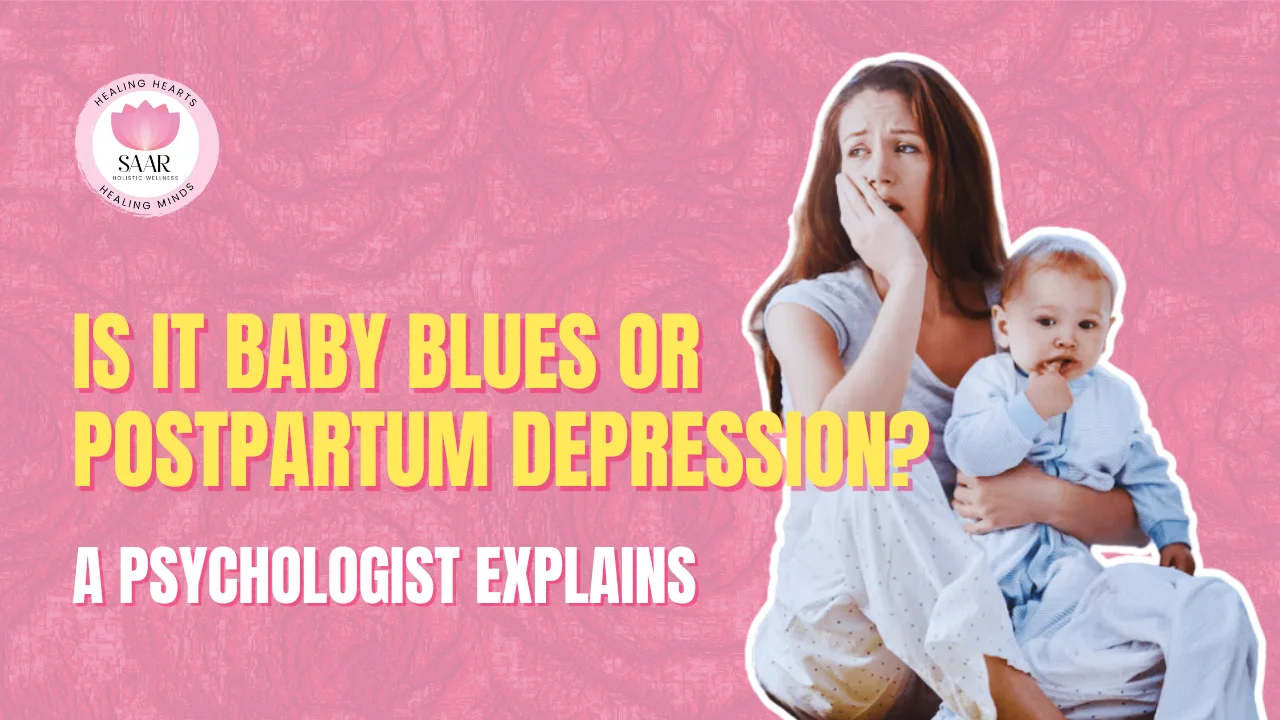
In my 20 years of working with families, one of the most common conversations I find myself having is with new mothers who are quietly struggling and quietly wondering if something is wrong with them. They’ve just brought a new life into the world. Everyone around them is celebrating. And yet, they feel sad, exhausted, anxious, or simply unlike themselves. And then comes the guilt: Why am I not happy? What kind of mother feels this way?
Today, I want to talk about something that doesn’t get nearly enough honest conversation in Indian families: the difference between baby blues and postpartum depression. Because knowing the difference isn’t just helpful. For many mothers, it can be life-changing.
The numbers tell a clear story. According to the World Health Organization, 1 in 5 mothers in India experiences postpartum depression. India’s National Mental Health Survey (2016) found that 20% of all depressed individuals in the country were either pregnant women or new mothers. And yet, most cases go unrecognised and untreated not because help isn’t available, but because we don’t talk about this enough, and mothers are left to wonder if what they’re feeling is normal.
Let’s change that.
What Are Baby Blues And Why Do They Happen?
Almost every new mother experiences what we call the “baby blues” in the first few days after delivery. Research suggests that between 50% and 80% of new mothers go through some form of baby blues after childbirth. You might find yourself crying without a clear reason, feeling irritable or overwhelmed, or swinging between moments of joy and inexplicable sadness. You may feel anxious about whether you’re doing things right, or simply bone-tired in a way sleep doesn’t seem to fix.
This is not a sign that something is wrong with you. It is your body and mind adjusting to one of the biggest transitions of your life.
After childbirth, estrogen and progesterone levels drop sharply; some studies describe this as among the most significant hormonal shifts the human body can experience in a short period of time. This drop, combined with sleep deprivation, physical recovery, and the sheer weight of a new responsibility, creates a perfect storm of emotional vulnerability. Baby blues typically begin within the first two to three days after delivery and resolve on their own within two weeks. They are common, they are temporary, and they do not require clinical treatment though they do require rest, support, and gentleness.
What Postpartum Depression Actually Feels Like
Postpartum depression (PPD) is different and it’s important to understand why.
Where baby blues are like a passing storm, postpartum depression is more like a fog that doesn’t lift. Studies from different parts of India place the prevalence of PPD anywhere between 6.8% and 21.5%, depending on geography, support systems, and socioeconomic conditions (Agarwala et al., 2019; Shriraam et al., 2019). Globally, up to 20% of women worldwide experience PPD making it one of the most common complications of childbirth, and one of the most undertreated.
PPD can begin within the first four weeks after delivery, but it can also develop gradually over the first few months. Some mothers don’t recognise it until they’re several months in.
PPD doesn’t always look like crying all day. In my practice, I’ve seen mothers who describe it as feeling completely numb going through the motions of caring for their baby but feeling disconnected from the experience. Some describe an inability to bond with the baby that fills them with shame. Others feel relentless anxiety, constant fear that something will happen to the child, or intrusive thoughts that disturb them deeply.
Here is what PPD can look like:
- Persistent sadness, emptiness, or hopelessness that lasts more than two weeks
- Feeling detached from your baby, or unable to feel the love you expected to feel
- Difficulty sleeping even when the baby sleeps, or sleeping far more than usual
- Loss of appetite or eating without feeling any pleasure
- Difficulty concentrating, making decisions, or remembering things
- Withdrawal from family, friends, and activities that once brought joy
- Intense anxiety, irritability, or anger that feels disproportionate
- Intrusive thoughts about harming yourself or your baby
That last point is particularly important. Research shows that up to 70% of new mothers experience intrusive thoughts in the postpartum period, thoughts that disturb and frighten them. They are one of the reasons so many women stay silent. They feel ashamed to say it out loud. But experiencing these thoughts does not make you dangerous. It makes you someone who needs support, and who deserves to receive it without judgment.
Why Indian Mothers Often Suffer in Silence
There is a cultural script around Indian motherhood that is deeply embedded: a good mother is selfless, nurturing, endlessly patient, and grateful. Motherhood is celebrated as the ultimate fulfillment. In this framework, admitting that you are struggling feels like a confession of failure.
The data reflects exactly this silence. A study on postpartum depression literacy among Indian mothers found significant gaps in awareness that women were either unaware that PPD was a medical condition, or minimised their own symptoms to avoid being seen as unfit or weak (ScienceDirect, 2021). According to research, despite a high prevalence of PPD in India, the condition often goes unrecognised and untreated, with low mental health literacy cited as a key barrier to seeking help.
Add to this the reality of many Indian households: a new mother surrounded by extended family, well-meaning but often overwhelming advice, pressure to breastfeed, recover quickly, perform rituals, and appear joyful and you have a situation where a woman’s internal distress has almost no space to be acknowledged.
Many mothers I’ve worked with spent months telling themselves they were just tired, just adjusting, just being dramatic before finally recognising that what they were carrying was something that needed real care. The delay often came at a significant cost to both themselves and their relationship with their baby.
Postpartum depression in India often goes unrecognised not because it isn’t real, but because we haven’t built enough space for it to be named.
How to Tell the Difference: A Simple Guide
Here is what I tell mothers when they’re trying to figure out where they stand:
Baby blues typically begin within 2–3 days of delivery, last no longer than two weeks, and ease with rest and support. The emotions, though intense, come and go. You still have moments where you feel like yourself.
Postpartum depression lasts longer than two weeks, may intensify over time rather than ease, and significantly affects your ability to function, your sleep, your appetite, your connection to your baby, your relationship with others. The heaviness doesn’t lift with a good night’s sleep or a kind word.
One useful clinical marker: the Edinburgh Postnatal Depression Scale (EPDS) is a validated 10-question screening tool widely used by mental health professionals to identify PPD. Research shows that when this screening is used systematically, the rate of PPD diagnosis rises from around 3.7% to over 10% which tells us clearly that many cases exist that simply aren’t being caught. If you have access to a mental health professional, ask about this screening. It takes less than five minutes and can make an enormous difference.
If you are reading this and recognising yourself if the fog has lasted longer than two weeks, if you feel like you’re disappearing inside your own life please don’t wait for it to pass on its own.
What Helps: From Support to Professional Care
Postpartum depression is treatable. That is not a platitude, it is a clinical fact. Research consistently shows that early intervention for PPD significantly reduces both the severity and duration of symptoms, and also protects against long-term effects on the mother–child relationship and the child’s development (PubMed, 2022).
What helps varies by person, but typically includes a combination of the following.
Talking about it is, in itself, therapeutic. Telling one trusted person a partner, a friend, a sister breaks the isolation that PPD feeds on. It also makes it more likely that you’ll take the next step.
Professional support, whether through psychotherapy, counselling, or in some cases medication, makes a significant difference. Cognitive approaches that address cycles of negative thought are particularly effective for postpartum depression and anxiety. If you’re in India, seeking a psychologist or psychiatrist with experience in perinatal mental health is a meaningful first step.
Research also shows that women with strong support systems report notably lower levels of postpartum anxiety and depression (Journal of Women’s Health, 2023). This matters. It means asking for help, accepting help, and building that net around you is not weakness, it is evidence-based self-care.
Sleep and practical support matter more than we give them credit for. Studies confirm that sleep deprivation significantly increases the risk of developing PPD and postpartum anxiety. If someone can take a night feed, take the baby for a few hours, or simply sit with you, accept that help without guilt.
You Are Not a Bad Mother for Feeling This
Postpartum depression is not a character flaw. It is not ingratitude. It is not a weakness, and it is certainly not evidence that you don’t love your baby. It is a medical condition that affects 1 in 5 mothers in India and one that responds to care and support.
Published research confirms that postpartum depression has a measurable negative impact on a child’s cognitive development, language, and behaviour when it goes untreated (ScienceDirect, 2021). I share that not to add to a mother’s burden, but to reframe something important: getting help is not just an act of self-care. It is one of the most powerful things you can do for your child.
The mother who reaches out for help is not failing her child. She is doing the bravest, most loving thing she can, choosing to get better so she can show up fully for the life she’s building.
If anything I’ve written here has resonated with you, I want you to know that what you’re feeling is real, it is valid, and it is not permanent.


