
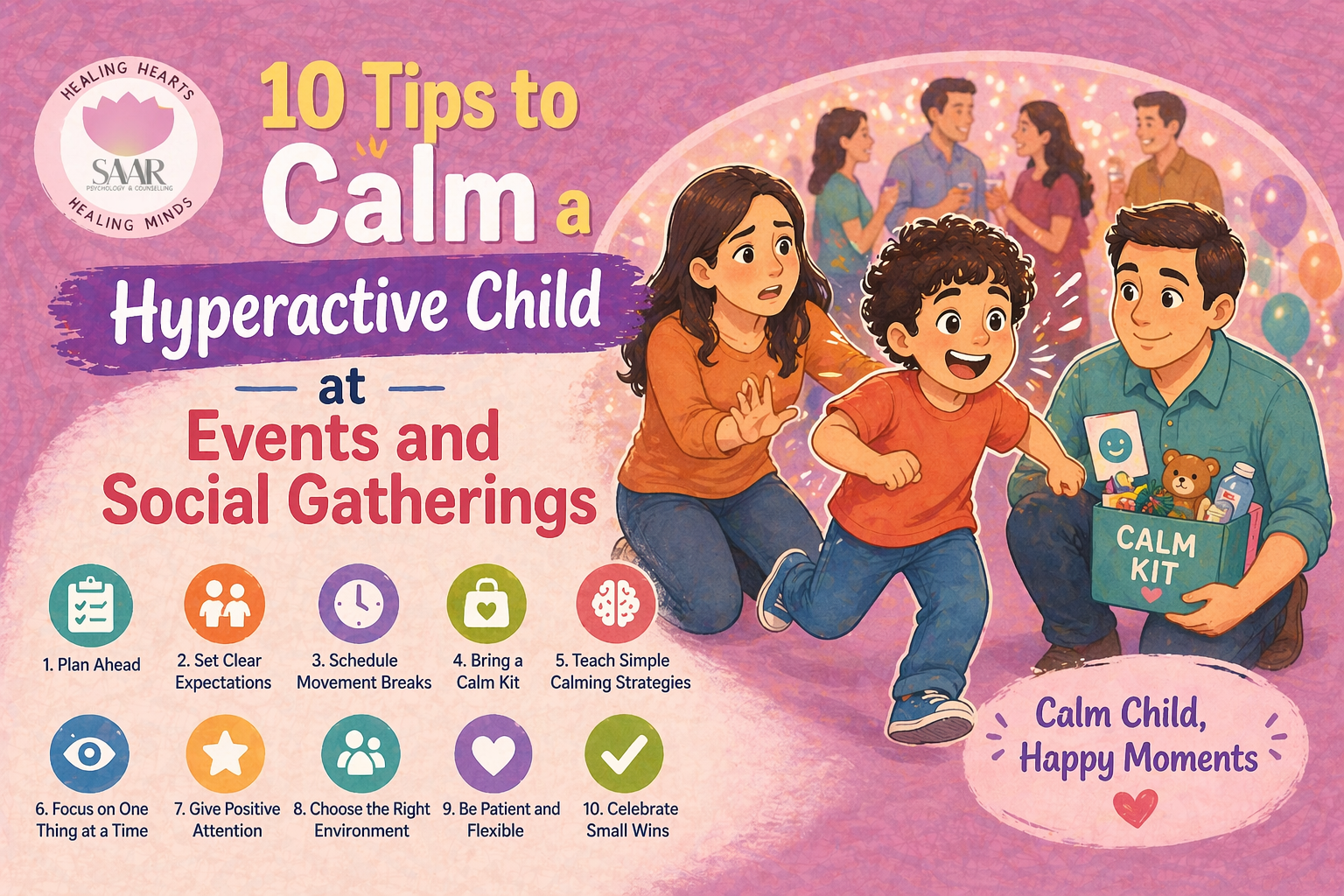
When Outings Feel More Stressful Than Enjoyable
You get ready for a family function, a wedding, or a birthday party thinking it will be fun.
But once you reach there, your child:
- Starts running around
- Shouts loudly
- Interrupts conversations
- Gets overexcited
- Refuses to sit
And suddenly, instead of enjoying the event, you’re:
- Chasing your child
- Feeling judged by others
- Getting unwanted advice
- Feeling embarrassed and exhausted
If this sounds familiar, you’re not alone.
Managing a hyperactive child in social settings is challenging but with the right approach, it can become easier.
Why Events Are Hard for Hyperactive Kids
Social gatherings are full of:
- Noise
- People
- Excitement
- New environments
- Less structure
For hyperactive children, this can lead to sensory overload and loss of control.
So what you see as “misbehavior” is often overstimulation.
10 Practical Tips to Calm a Hyperactive Child at Events
1️⃣ Prepare Your Child Before the Event
Talk to your child before leaving:
- Where you’re going
- What will happen
- What behavior is expected
Preparation reduces surprises and surprises trigger hyperactivity.
2️⃣ Set Simple, Clear Expectations
Don’t give long lectures.
Instead say:
👉 “We will stay with me.”
👉 “We will use a soft voice.”
Keep it simple and realistic.
3️⃣ Arrive Early (When It’s Less Overwhelming)
Crowds and noise increase excitement.
Arriving early helps your child adjust gradually.
4️⃣ Allow Movement Breaks
Expecting a hyperactive child to sit for long periods is unrealistic.
Give short breaks:
- Walk outside
- Let them move safely
- Let them release energy
Movement helps them regulate.
5️⃣ Carry Familiar Comfort Items
Bring:
- A favorite toy
- A snack
- Something familiar
Familiarity helps reduce anxiety and overstimulation.
6️⃣ Stay Close Your Presence Regulates Them
Your child feels safer when you are physically close.
Distance increases impulsive behavior.
7️⃣ Use Calm Signals Instead of Public Scolding
Avoid shouting or scolding in public.
Instead:
- Use eye contact
- Gentle touch
- Short reminders
This protects your child’s confidence.
8️⃣ Watch for Early Signs of Overstimulation
Before a meltdown, children show signs:
- Increased movement
- Loud voice
- Restlessness
Act early take a break before it escalates.
9️⃣ Don’t Compare With Other Children
Every child is different.
Comparison increases your stress and your child’s pressure.
🔟 Know When to Leave
Sometimes, the best decision is to leave early.
This is not failure it is understanding your child’s limit.
💛 A Special Note for Mothers
Let’s be honest events can feel more stressful for mothers than children.
You are:
- Managing your child
- Managing people’s opinions
- Trying to “look in control”
- Feeling judged constantly
And when your child becomes hyper, the first thing people say is:
👉 “Control your child.”
But they don’t see:
- Your effort
- Your patience
- Your emotional exhaustion
So remember:
👉 You are not failing in public
👉 You are supporting your child in a difficult environment
That takes strength.
If social events feel like:
- A constant struggle
- A source of stress
- A place where you feel judged
- A situation you start avoiding
You don’t have to handle this alone.
Our one-to-one parenting counselling sessions help parents:
- Understand hyperactive behavior in social settings
- Learn calming and regulation strategies
- Handle public situations confidently
- Reduce stress and guilt
👉 Book a session today because parenting doesn’t come with a manual, but support makes it easier.
A Gentle Reminder
Your child is not trying to embarrass you.
Your child is trying to handle a big environment with small coping skills.
And with your support, they will learn step by step.


