
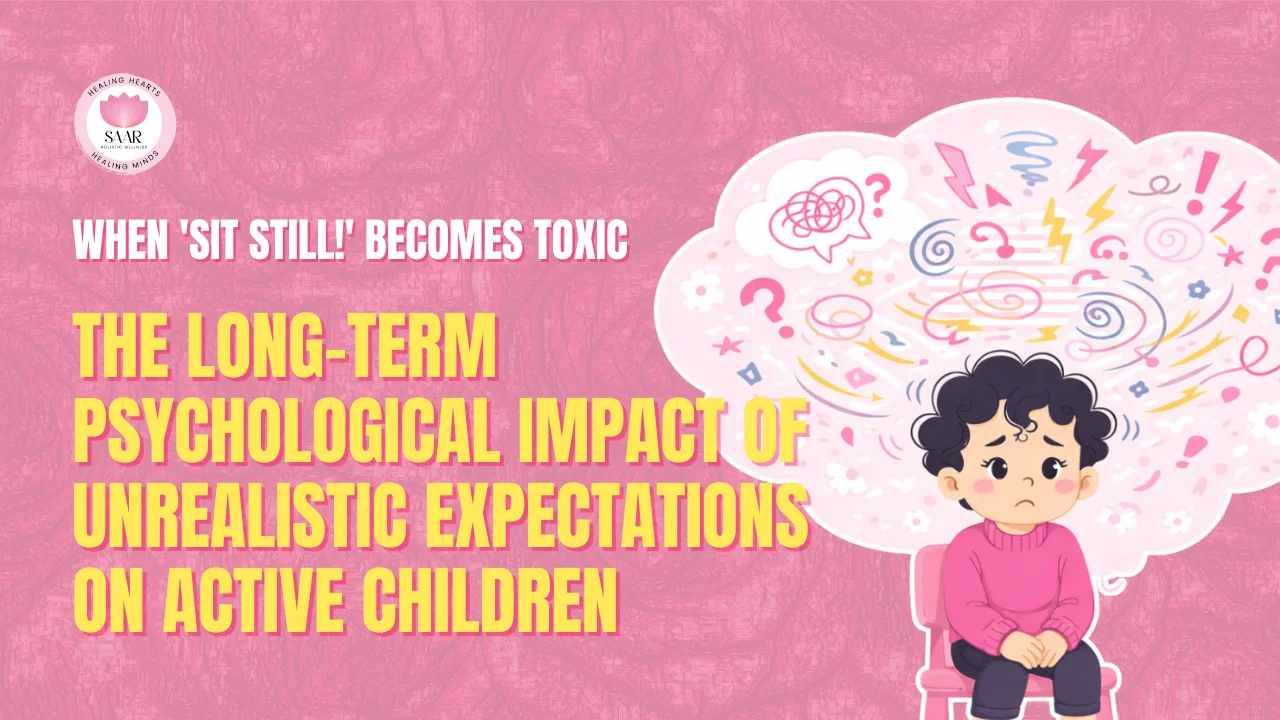
In my years of working with children and families, one of the most common things I hear from parents is this: “I just don’t understand why he can’t sit still for five minutes.” Or, “She’s been told so many times why doesn’t she listen?”
I understand the exhaustion behind those words. Raising a high-energy child is genuinely tiring. But there’s something important I’ve come to see in my clinical practice, something that doesn’t get talked about enough.
When children repeatedly hear that their natural way of being is wrong, the damage goes deeper than behaviour. It goes into how they see themselves.
As a child psychologist, I want to walk you through what the research and my clinical experience actually show because understanding the ‘why’ is what helps parents respond differently.
What We Know About Active Children (And What Most People Don’t)
Not all children who struggle to sit still have ADHD. Many are what we call high-energy or sensory-seeking children whose nervous systems are wired to need more movement, more stimulation, more engagement with the world around them.
From a neuroscience standpoint, these children often have a more active dopamine system. Their brains are quite literally seeking input. Stillness doesn’t come naturally not because they’re being defiant, but because their biology makes sustained inactivity genuinely uncomfortable.
When we understand this, the instruction “sit still” starts to look very different. We’re essentially asking a child to override their neurological wiring, repeatedly, every day and then expressing frustration when they can’t.
How Impossible Demands Create a Cycle of Failure
Here’s what happens when a child is consistently told to do something their brain isn’t designed to do.
They try. They fail. They get corrected, scolded, or punished. They try again. They fail again.
Over time, this cycle stops being about behaviour. It becomes about identity. The child starts to believe: I am the problem.
In clinical terms, this is called learned helplessness, a pattern first identified by psychologist Martin Seligman. When children experience repeated failure despite their best efforts, they eventually stop trying. Not out of laziness, but out of a deeply held belief that nothing they do will ever be good enough.
I see this in my practice regularly. Children who are labelled “difficult” or “defiant” at seven or eight years old often come to me at twelve or fourteen with anxiety, low self-worth, and a complete withdrawal from trying in school, in friendships, in life.
The Shame That Gets Carried Silently
Shame is different from guilt. Guilt says, “I did something wrong.” Shame says, “I am doing something wrong.”
Active children who are constantly corrected for how they naturally exist in the world are too loud, too restless, too much to absorb shame in very quiet ways. They don’t always act out. Often, they internalise.
They become the child who avoids situations where they might “mess up.” The teenager who stops raising their hand in class. The young adult who holds back in relationships because they’ve learned, somewhere deep down, that who they are is hard for people to handle.
This isn’t dramatic. It’s what I’ve watched unfold in families where no one was trying to cause harm. Parents love their children fiercely and still, the daily drip of correction and frustration leaves a mark.
What It Does to the Parent-Child Relationship
When expectations are consistently unrealistic, something else starts to shift the connection between parent and child begins to fray.
The child stops coming to the parent with small things, because small things have so often led to correction. The parent feels shut out and doesn’t understand why. Both are hurting. Neither knows how to close the gap.
What I often tell parents is this: your child isn’t pulling away from you. They’re protecting themselves from the feeling of not being enough. And that protection starts very early.
The repair is possible but it starts with understanding what the child has been carrying.
What to Do Instead: Small Shifts, Real Impact
I’m not asking parents to stop having expectations. Structure and guidance are important. But there’s a meaningful difference between expectations that stretch a child and expectations that break them.
Here are a few reframes I use with families in my practice:
- Replace “sit still” with movement breaks. Give the child permission to move within limits, a five-minute walk, stretching, and fidget tools. You’ll get more compliance in the minutes that follow than an hour of enforcing stillness.
- Separate the behaviour from the child. “That was too loud for this space” is different from “You’re always so loud.” Language matters more than we realise.
- Notice what they do well. Active children are often creative, energetic, and deeply feeling. Name those qualities out loud. Children who feel seen in their strengths are more willing to work on their challenges.
- Adjust the environment before adjusting the child. Sometimes the problem isn’t the child, it’s a setting that isn’t built for how their nervous system works. Asking that question first is an act of respect.
A Final Word to Parents
If you’ve been struggling with a high-energy child, I want you to know something: the fact that you’re reading this means you care. Deeply.
Parenting an active child is exhausting, and it’s okay to admit that. What I hope you’ll also hold onto is that your child is not broken, and neither are you.
The expectations placed on children to be still, quiet, and compliant have roots in systems that were never designed with every kind of child in mind. You have the power to create a different experience at home. One where your child learns that who they are, all of it, is not too much.
That shift from “why can’t you just behave” to “let me understand how you work” is where healing begins. For both of you.


