
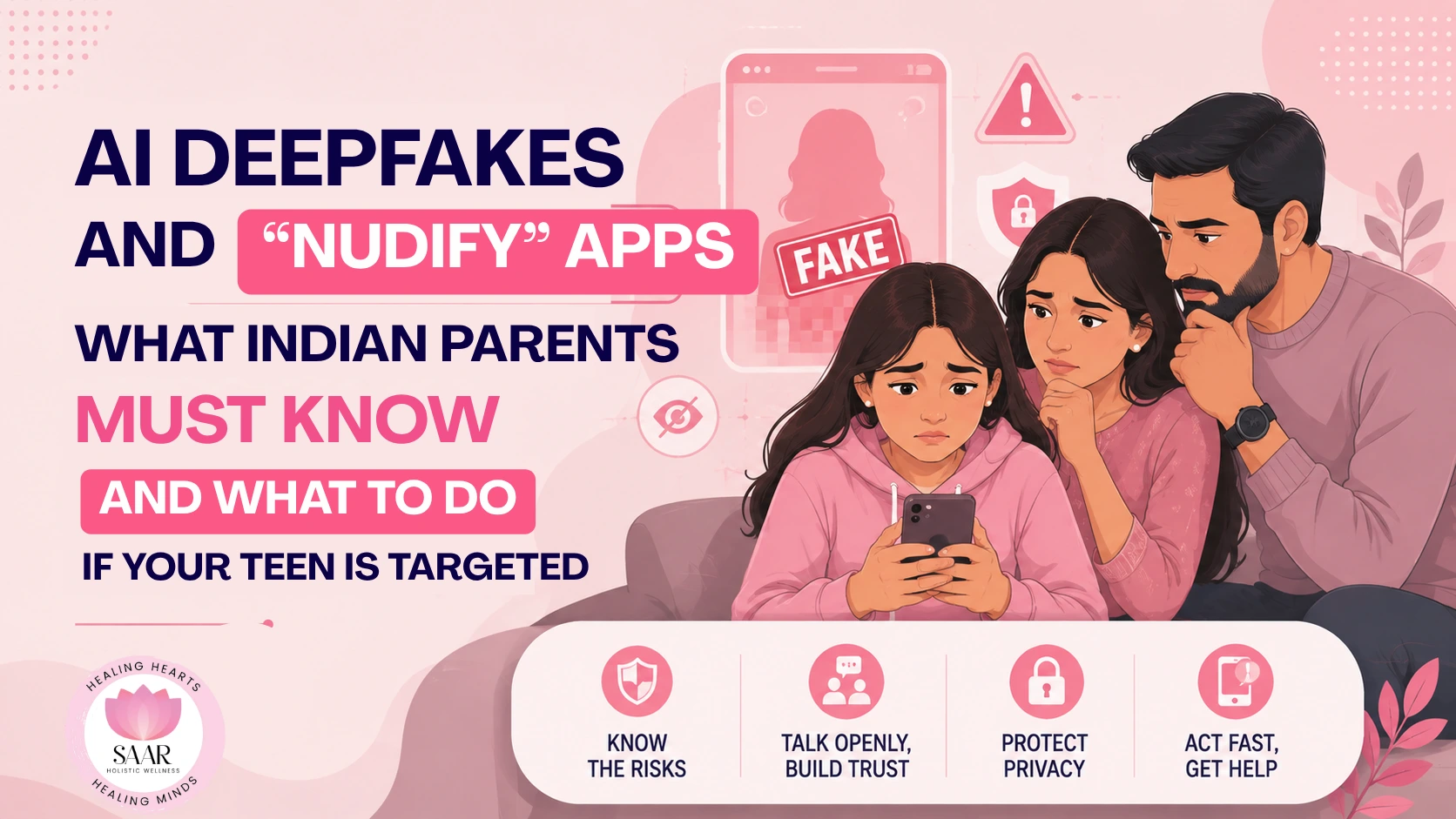
A teenager’s ordinary photograph which can be a school picture, dance video, Instagram post, or even a face cropped from a family WhatsApp group, can now be misused to create a fake sexualised image or video.
This is one of the most frightening developments in online safety for families. It can lead to humiliation, panic, bullying, blackmail, school avoidance, and deep shame for a young person who has done nothing wrong.
The most important message for parents and teens is this:
If someone creates, shares, threatens to share, or uses AI to sexualise a teen’s image, the teen is not at fault.
A LocalCircles survey of more than 89,000 urban Indian parents of children aged 9–17 reported that, among 18,264 respondents asked about harmful experiences, 46% reported AI photo/video morphing or deepfake misuse. This is parent-reported, urban, non-probability survey evidence not a national prevalence rate. But it shows why parents need a calm plan before or after something goes wrong.
Psychologist Reena Chopra, founder of Saar Holistic Wellness, urges families to treat an incident as both a cyber-safety issue and an emotional-safety issue. Your teen may need practical reporting help, protection from further sharing, and steady reassurance that they do not have to face it alone.
What Are AI Deepfakes and “Nudify” Apps?
An AI deepfake is an image, video, or audio clip made or altered with artificial intelligence so that it appears real.
“Nudify” apps and websites use AI to generate fake nude, sexualised, or intimate-looking images from a normal photograph. The result may be completely fabricated, but the harm can still be real.
These tools may be used to:
- Bully or humiliate a student
- Threaten someone into sending money or images
- Spread fake sexual content in school groups
- Harass an ex-partner or classmate
- Create non-consensual intimate imagery
- Target girls, boys, or gender-diverse teens
Whether or not an image is “real” is not the point. Creating or sharing sexualised fake content of a child is harmful and needs urgent adult action.
Why This Can Be So Devastating for Teenagers
A targeted teen may feel:
- Shock, fear, or disbelief
- Shame or embarrassment
- Panic about family, school, or relatives finding out
- Anger and a desire to retaliate
- Fear that no one will believe the image is fake
- Pressure to pay or send more images to make it stop
- Thoughts of leaving school, disappearing, self-harming, or ending their life
They may also be worried that they will be blamed for posting a photo, using social media, trusting someone, or “not being careful enough.”
Do not ask, “Why did you send a photo?” before you say, “I believe you. This is not your fault.”
Even a public, fully clothed photograph does not make a teen responsible for someone else’s abuse or misuse.
What to Do Immediately if Your Teen Is Targeted
The first hour matters. Try to stay steady, even if you are angry or frightened. Your calm can reduce your teen’s panic.
1. Believe Them and Protect Them From Blame
Start with these words:
“I believe you.”
“You are not in trouble.”
“This is not your fault.”
“We will deal with this together.”
Do not demand every detail immediately. Your teen may be scared, embarrassed, or in shock.
2. Check Immediate Safety
Ask gently whether anyone has threatened them, demanded money or images, knows their address or school, or is pressuring them to meet in person.
If there is an immediate physical threat, blackmail, stalking, self-harm risk, or danger at school, contact emergency services and a trusted adult at school promptly. In India, call 112 for an emergency.
3. Preserve Evidence Without Repeatedly Viewing the Image
Before reporting or blocking, save the information that can help a report:
- Screenshots showing the account name, date, time, threats, and messages
- The profile URL, post URL, group name, or platform details
- Usernames, phone numbers, email addresses, or payment requests connected to the abuse
- A note of where and when the content was seen
Avoid downloading, forwarding, or repeatedly opening sexualised images especially when a child is involved. Preserve only what is necessary for reporting, and do not share it in family groups or with friends “to ask what to do.”
Do not ask your teen to keep looking at the content to prove what happened.
4. Do Not Pay, Bargain, or Send More Images
If someone is extorting your teen, do not pay or send more pictures in the hope that they will stop. Payment or compliance often does not end the abuse and may increase demands.
Do not try to negotiate alone with the person. Preserve evidence and report.
5. Report the Content on the Platform
Use the platform’s reporting option for non-consensual intimate imagery, sexual exploitation, harassment, impersonation, or child safety, as applicable.
Ask for removal and keep a record of the report confirmation. If the content has been shared across several platforms, report each location.
6. Report the Incident Through India’s Cybercrime System
In India, cybercrime incidents can be reported at cybercrime.gov.in. The cybercrime helpline is 1930.
When filing a report, share factual details and the evidence you preserved. If possible, keep the complaint/reference number and follow up through the official process.
The Ministry of Electronics and IT’s February 2026 IT Rules amendments address synthetic-content harms, including non-consensual intimate imagery and content harmful to children. The precise legal route can depend on the facts of an incident, so a cybercrime authority or legal professional can guide you on next steps.
7. Tell the School Only as Much as Is Needed for Safety
If classmates, a school group, or a school device are involved, contact a trusted school leader or counsellor. Ask for a confidential response, removal from school groups, anti-bullying protection, and steps to prevent further circulation.
Your child should not be forced to retell the incident repeatedly to multiple adults. Agree on one or two trusted points of contact.
What Parents Should Not Do
In a crisis, even caring parents can make things harder without meaning to.
Try not to:
- Blame the teen for posting photos or using social media
- Shame, shout, or threaten to take away their phone as the first response
- Forward the image to relatives, friends, or class groups
- Confront the alleged perpetrator online in a way that escalates risk
- Pay a blackmailer or send more content
- Make the teen repeatedly describe or view the image
- Promise secrecy if immediate safety requires adult reporting
- Treat the incident as “drama” because the image is fake
A fake image can cause real trauma.
How to Support Your Teen Emotionally After a Deepfake Incident
Technical takedowns are important, but they may not settle the fear in your teen’s body.
Keep Reassuring Them
Your teen may ask the same questions repeatedly: “What if everyone saw it?” “What if it comes back?” “What will school think?”
Answer calmly and honestly. Do not make promises you cannot keep, such as “No one will ever see it.” Instead say:
“We will keep taking steps to report it. You did nothing wrong. I will stay with you through this.”
Restore Small Pieces of Control
Ask your teen what would help them feel safer today. They may want a day off school, help blocking accounts, a different route home, a trusted teacher informed, or someone to sit with them while they report.
Offer choices wherever you can. Abuse takes away control; supportive choices help return it.
Watch for Trauma, Anxiety, or Depression
Seek professional support if your teen has persistent fear, panic, nightmares, withdrawal, shame, school refusal, sleep changes, anger, low mood, or self-blame.
Seek urgent help immediately if they talk about self-harm, suicide, or not wanting to live. Do not leave them alone if you believe there is immediate risk. Call 112, go to the nearest emergency department, or seek urgent local mental-health support.
Counselling does not mean your teen is weak. It can give them a confidential place to process what happened and rebuild a sense of safety.
How to Reduce Risk Before Anything Happens
No safety plan can prevent every form of abuse. Responsibility always lies with the person who creates or shares harmful content. Still, families can reduce exposure and improve readiness.
Talk Before There Is a Crisis
Use calm, direct language:
“Someone can misuse even an ordinary photo with AI. If you ever see something about yourself or a friend, you can tell me. You will not be blamed or punished for coming to me.”
This statement can make it much more likely that a teen asks for help early.
Review Privacy Settings Together
Check who can see posts, tag your teen, download or remix content, add them to groups, and contact them. Encourage teens to keep accounts private where appropriate and to be selective about accepting followers.
Privacy settings reduce risk but do not make sharing impossible. Avoid implying that a teen who is targeted failed to protect themselves.
Keep Identifying Details Off Public Posts
Avoid publicly sharing school ID cards, home addresses, routine locations, live locations, travel plans, phone numbers, or images that reveal sensitive details.
Teach teens to pause before sharing a high-resolution image, a uniform photo with school information, or a location-tagged post.
Create a “Pause and Tell” Rule
Tell your teen to pause and speak to a trusted adult if someone online asks for:
- Intimate images or video calls
- A secret relationship
- Money, gift cards, or OTPs
- Personal documents or location
- Images of a friend or classmate
- Help using a deepfake or nudify tool
If a teen has made a mistake, the priority should be safety and reporting not punishment.
Speak About Consent in Everyday Language
A simple family rule is: Do not create, request, share, forward, joke about, or comment on sexualised images of anyone (real or AI-generated) without consent.
If the person is under 18, the seriousness is even greater. Tell teens that forwarding a fake image can still harm a classmate and may have serious consequences.
If Your Teen Has Seen or Shared a Deepfake of Someone Else
Do not respond with shame or panic. Make it clear that the content must not be forwarded, saved, joked about, or used to target another person.
Ask them to stop sharing immediately, preserve only the reporting details needed, and tell a trusted adult or school safeguarding contact. If they created or shared content, get appropriate legal and professional guidance. The aim is accountability, harm reduction, and learning not public humiliation.
Research Sources and Official Reporting Links
- A LocalCircles survey of more than 89,000 urban Indian parents of children aged 9–17 found that, among 18,264 respondents to a harms question, 46% reported AI photo/video morphing or deepfake misuse. It is parent-reported, urban, non-probability survey evidence. Read More…
- India’s Ministry of Electronics and IT explains the February 2026 IT Rules amendments relating to synthetic-content harms, including non-consensual intimate imagery and content harmful to children. Read More…
- India’s official National Cyber Crime Reporting Portal: cybercrime.gov.in. The cybercrime helpline is 1930. Read More…
- Institute for Strategic Dialogue research reported that social networks referred more than 5.7 million visits to nudify websites between December 2025 and March 2026. This is global access evidence, not an India victimisation statistic. Read More…
If your teen is targeted by an AI deepfake or nudify image, the first message they need is: “I believe you, and this is not your fault.”


