
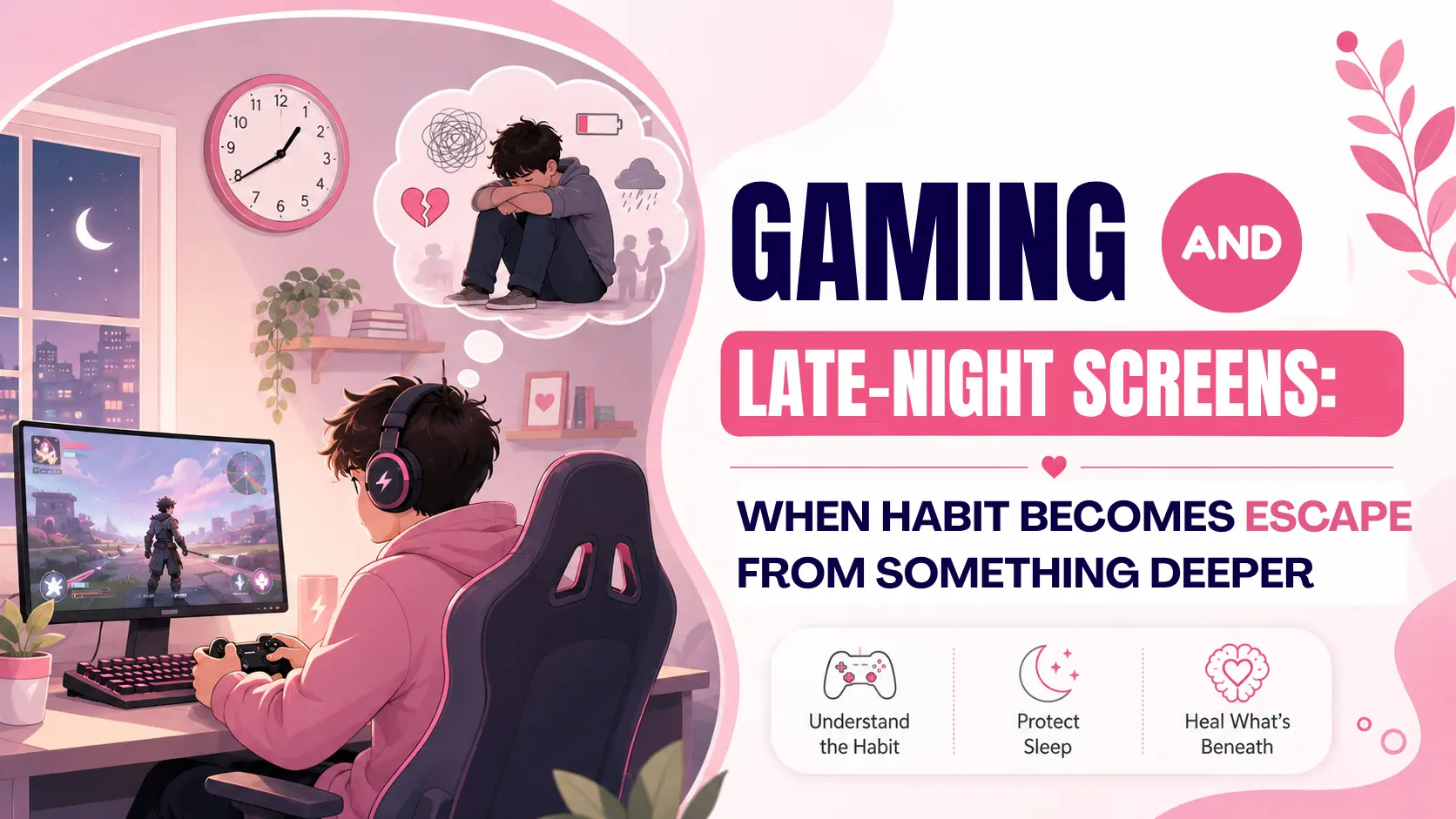
Teenagers today spend an average of over 15 hours a week gaming, and that number keeps rising every year. On its own, that isn’t a red flag; gaming is simply how a lot of today’s teenagers relax and connect with friends. But in my practice, what I look at isn’t the hours on the screen. It’s what’s happening underneath them. A recent Indian study found that adolescents with more than 4 hours of daily screen time were significantly more likely to show signs of gaming addiction and elevated stress, and the effect was strongest among urban teenagers, the very group already juggling school, coaching classes, and social pressure all at once.
I often tell parents: gaming itself is rarely the problem. Gaming as the only place a teenager feels calm, capable, or in control, that’s worth paying attention to.
Why Late-Night Gaming Isn’t Always About the Game
Research on gaming behaviour consistently points to one motive standing out above “fun” or “competition”: escape. For many teenagers, especially those under real-world pressure, whether academic, social, or emotional, a game offers something the rest of the day doesn’t: clear rules, visible progress, and a sense of control that real life, right now, doesn’t seem to offer.
Late at night specifically, gaming often becomes something else too, a way to avoid a mind that won’t quiet down. If a teenager lies in bed and immediately starts thinking about exam pressure, a friendship conflict, or something they haven’t told anyone, picking up a controller can feel far easier than lying alone with those thoughts. Nearly 4 in 10 teen gamers say gaming has hurt their sleep quality, yet only about a third have ever tried, on their own, to cut back.
I remember a fourteen-year-old boy brought to me by his parents, who were convinced his 1 am gaming sessions were simple defiance. A few sessions in, it became clear he was gaming to avoid a recurring worry about being teased at school. The game was the one part of his day where nobody could reach him. The gaming wasn’t rebellion. It was refuge.
The Difference Between a Habit and an Escape
Not every late-night gaming session is a sign of something deeper. Here’s how I help parents tell the difference:
It’s likely just a habit if: your teen games for a set window, can stop when asked (even if grumbling), still shows up for friends, family, and schoolwork, and generally seems like themselves otherwise.
It’s worth a closer look if: gaming is the only thing they seem to look forward to, they become unusually irritable or anxious when it’s taken away, their sleep, grades, or friendships are visibly slipping, or they seem to be gaming specifically to avoid thinking about something, rather than simply to enjoy it.
I find it useful to ask parents one simple question: if you took gaming away completely for a week, what do you think you’d see? If the honest answer is “probably a rough couple of days, then he’d be fine,” that’s a habit. If the answer is “I genuinely don’t know what he’d do with himself,” that’s worth exploring further.
What’s Often Underneath It
In my clinic, when I dig a little deeper with a teenager who games heavily late into the night, I often find one of a few things underneath: unspoken academic anxiety, especially around board exams or competitive coaching; social exhaustion from trying to keep up appearances all day; or a lack of any other space that feels genuinely theirs, free of expectation or evaluation.
Gaming, in these cases, isn’t the disease. It’s the coping mechanism a teenager found on their own, because nothing else was offered to them. In many Indian households, where “how do you feel” isn’t a question that comes up often at the dinner table, gaming quietly becomes the only outlet a teenager has built entirely on their own terms, which is exactly why taking it away without addressing what it’s covering rarely works.
How to Respond Without Starting a War
Get curious before you get strict. Instead of “turn it off and go to sleep,” try “what’s your favourite part of this game right now?” You’ll learn more about what it’s giving him emotionally than any lecture will teach you.
Set the boundary on sleep, not on gaming itself. A device curfew, say, an hour before bed, protects sleep without treating gaming as inherently bad, which usually backfires and drives it underground.
Offer a real alternative outlet, not just a replacement rule. If gaming is your teen’s only source of control and calm, taking it away without offering something else that meets that same need often just pushes the behaviour elsewhere, whether later at night or in secret.
Notice what happens on the nights they don’t game. Restlessness, low mood, or difficulty settling on screen-free nights can be a helpful clue about what the gaming has actually been managing all along.
Keep the conversation going, not just the rule. A curfew without context feels like control. A curfew explained as “I want your brain to actually rest so tomorrow feels easier” feels like care, and teenagers can usually tell the difference.
When to Look Deeper
If gaming has become the centre of your teenager’s world, displacing sleep, school, friendships, and family time consistently, and attempts to set limits lead to real distress rather than simple grumbling, it may be worth exploring what’s underneath with professional support, rather than treating it purely as a screen-time problem.


