
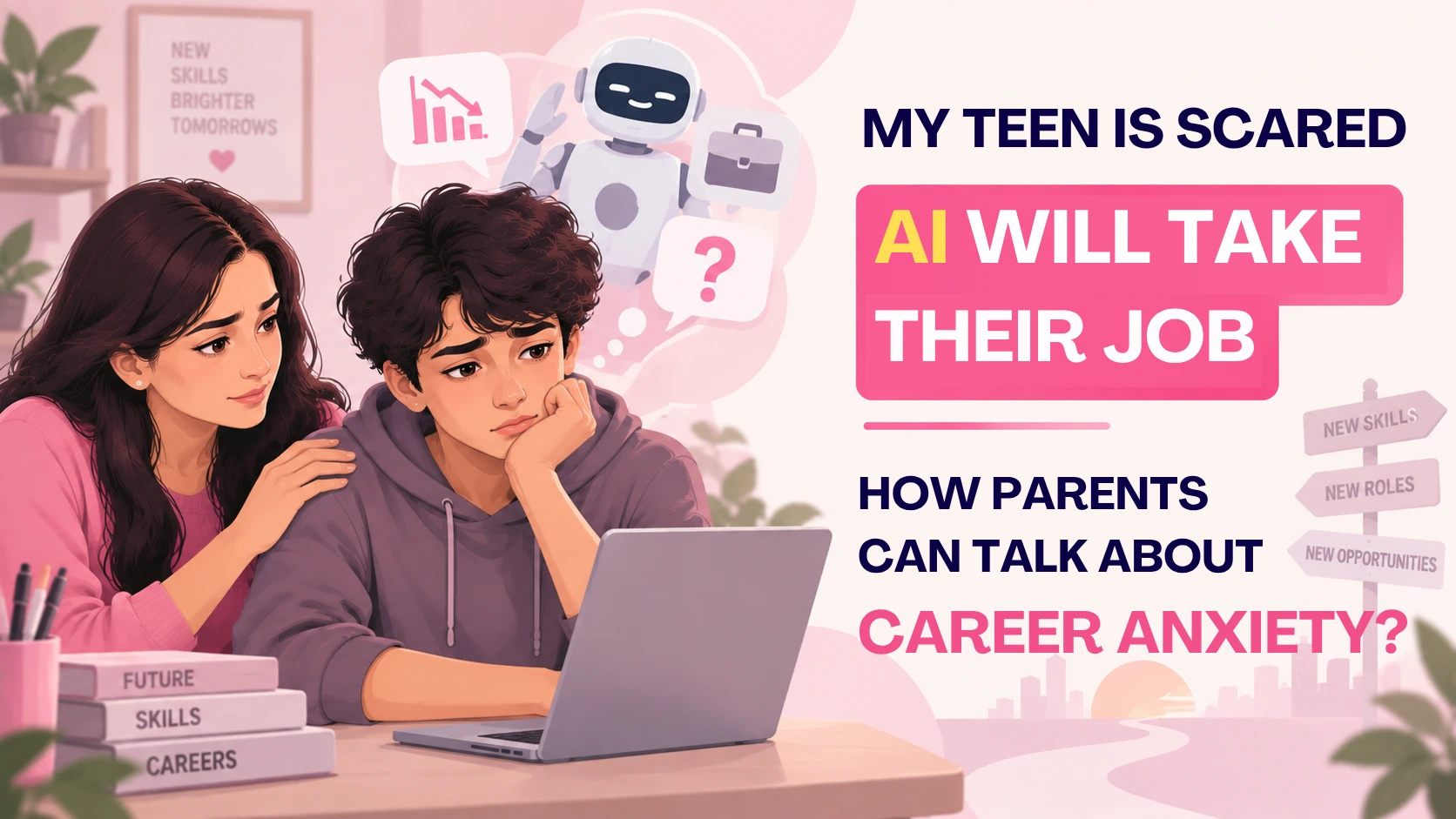
“Should I still study computer science?” “Will doctors, writers, designers, accountants, or lawyers be replaced?” “What is the point of working hard if AI can do it faster?”
These questions are increasingly appearing in Indian homes. For a teenager already carrying pressure about subjects, entrance exams, fees, college choices, and family expectations, AI can make the future feel even less certain.
A 2026 survey of 1,111 teenagers found that 61% believed AI would reduce job opportunities in many fields. This was US data, not Indian prevalence. Yet Indian parents are also rethinking “safe” careers as AI changes work and higher-education decisions.
Psychologist Reena Chopra of Saar Holistic Wellness encourages a steadier message: your teen does not need to predict the whole job market at 15 or 17. They need help building curiosity, adaptability, and a sense that their value is bigger than one course or one career label.
What Is Teen AI Career Anxiety?
Teen AI career anxiety is persistent worry about whether artificial intelligence will make a chosen course, career, skill, or dream irrelevant.
A teen may not use those exact words. It can sound like:
- “There is no point in studying.”
- “I will never get a job.”
- “Everyone else knows what the future will be.”
- “Mummy, tell me which career AI cannot replace.”
- “I have to choose perfectly now.”
Some concern is understandable. Careers will change. New roles will appear. Some routine tasks may be automated. But anxiety becomes unhelpful when it leads to panic, avoidance, paralysis, constant research, sleep problems, or a belief that every future is doomed.
Why AI Career Anxiety Feels So Intense for Indian Teenagers
For many Indian families, a course choice can feel like a life choice. There may be intense discussions about JEE, NEET, CUET, commerce, humanities, study abroad, placements, salary, and family investment.
AI adds uncertainty to decisions that already feel high-stakes.
“Safe Career” Thinking Can Increase Fear
Parents often ask, “Which field is secure?” That question comes from love and a desire to protect a child from financial difficulty. But no one can honestly guarantee a completely AI-proof career.
If the message becomes “choose the one perfect safe career,” a teen may feel trapped between fear of failure and fear of choosing wrong.
Social Media Makes Other Teens Look Certain
Online, teenagers see peers announcing coding achievements, internships, scholarships, “AI portfolios,” and plans for prestigious colleges. They may assume everyone else is prepared except them.
The Pressure Is Often About Identity, Not Only Employment
A teen may fear disappointing parents, wasting coaching fees, losing status, or being unable to support the family. Beneath “AI will take jobs” may be: “What if I am not good enough?”
The emotional question needs as much attention as the career question.
How Parents Can Talk About AI and Careers Without Adding Pressure
Start by Listening to the Specific Fear
Ask:
“When you say AI will take jobs, what are you most worried about choosing the wrong course, earning money, competing with others, or not knowing what you enjoy?”
Do not rush to say, “Everything will be fine.” It may sound comforting, but teens need space to name the uncertainty first.
Replace “Safe Career” With “Flexible Career Skills”
Instead of promising certainty, focus on capabilities that will matter across many paths:
- Learning how to learn
- Clear communication
- Critical thinking and fact-checking
- Creativity and curiosity
- Collaboration and empathy
- Ethical judgement
- Problem-solving in real situations
- Digital and AI literacy
- The ability to adapt after setbacks
These are not magical protections against job-market change. They are useful foundations for navigating it.
Separate Career Exploration From a Final Decision
Your teen may need permission to explore before committing. Encourage small experiments: a short course, volunteering, a project, speaking to someone in a field, job-shadowing where possible, reading about a role, or attending a college session.
A career conversation should not feel like a courtroom where the teen must defend one irreversible answer.
What Parents Should Avoid Saying About AI Careers
Try not to say:
- “That career is dead because of AI.”
- “Only engineering/medicine is safe.”
- “You need to beat everyone else.”
- “We are spending so much money, so do not make a mistake.”
- “Your cousin already knows what they are doing.”
- “Just learn coding; that will solve everything.”
These statements may come from worry, but they can make a teen’s uncertainty feel like failure.
A more helpful response is:
“The world is changing, and we will keep learning about it together. You do not have to have your whole life decided this year.”
A Practical Family Plan for AI Career Anxiety
1. Set a Limit on Doom-Scrolling Career Content
Endless videos about “jobs AI will destroy” can keep anxiety high without improving decision-making. Agree on a set time for career research, then return to schoolwork, rest, hobbies, friends, and ordinary life.
2. Learn AI Skills With Boundaries
Encourage your teen to understand AI tools: how to ask better questions, verify answers, use them ethically, protect privacy, and avoid passing off AI work as their own.
The goal is not to turn every teen into an AI expert. It is to help them become a thoughtful user rather than a frightened bystander.
3. Keep Interests in the Conversation
Ask what your teen notices, enjoys, values, and is willing to work at not only what sounds prestigious or secure. A sustainable career often requires both opportunity and genuine engagement.
4. Discuss More Than One Route
College, skill programmes, apprenticeships, internships, entrepreneurship, creative work, and changing directions later are all part of a wider future. Do not present one setback as the end of a life path.
5. Notice When Anxiety Needs More Than Career Advice
A career counsellor can help with options. A psychologist can help when fear is affecting sleep, self-worth, mood, concentration, relationships, or daily functioning.
When to Seek Support for Teen Career Anxiety
Consider professional support if your teen is:
- Having panic, insomnia, or physical anxiety about career decisions
- Unable to study because fear has become overwhelming
- Avoiding school, coaching, applications, or conversations about the future
- Constantly comparing themselves with peers
- Showing persistent low mood, hopelessness, or harsh self-criticism
- Saying their life has no value if they do not succeed in one path
- Talking about self-harm, suicide, or not wanting to live
If your teen mentions self-harm, suicide, or immediate danger, seek urgent local emergency or mental-health support. In India, call 112 in an emergency.
Research Sources for Publishing
- A 2026 survey of 1,111 US teens found that 61% believed AI would reduce job opportunities in many fields; this is useful context, not India prevalence data. Read More…
- September 2026 reporting documented Indian families rethinking established career pathways amid AI-driven uncertainty. Read More…
- OECD-related reporting notes a gap between many teenagers’ career expectations and changing labour-market demand. Read More…
Your teen does not need you to hand them a perfectly mapped future. They need you to stay steady beside them while they learn how to navigate an uncertain one.


