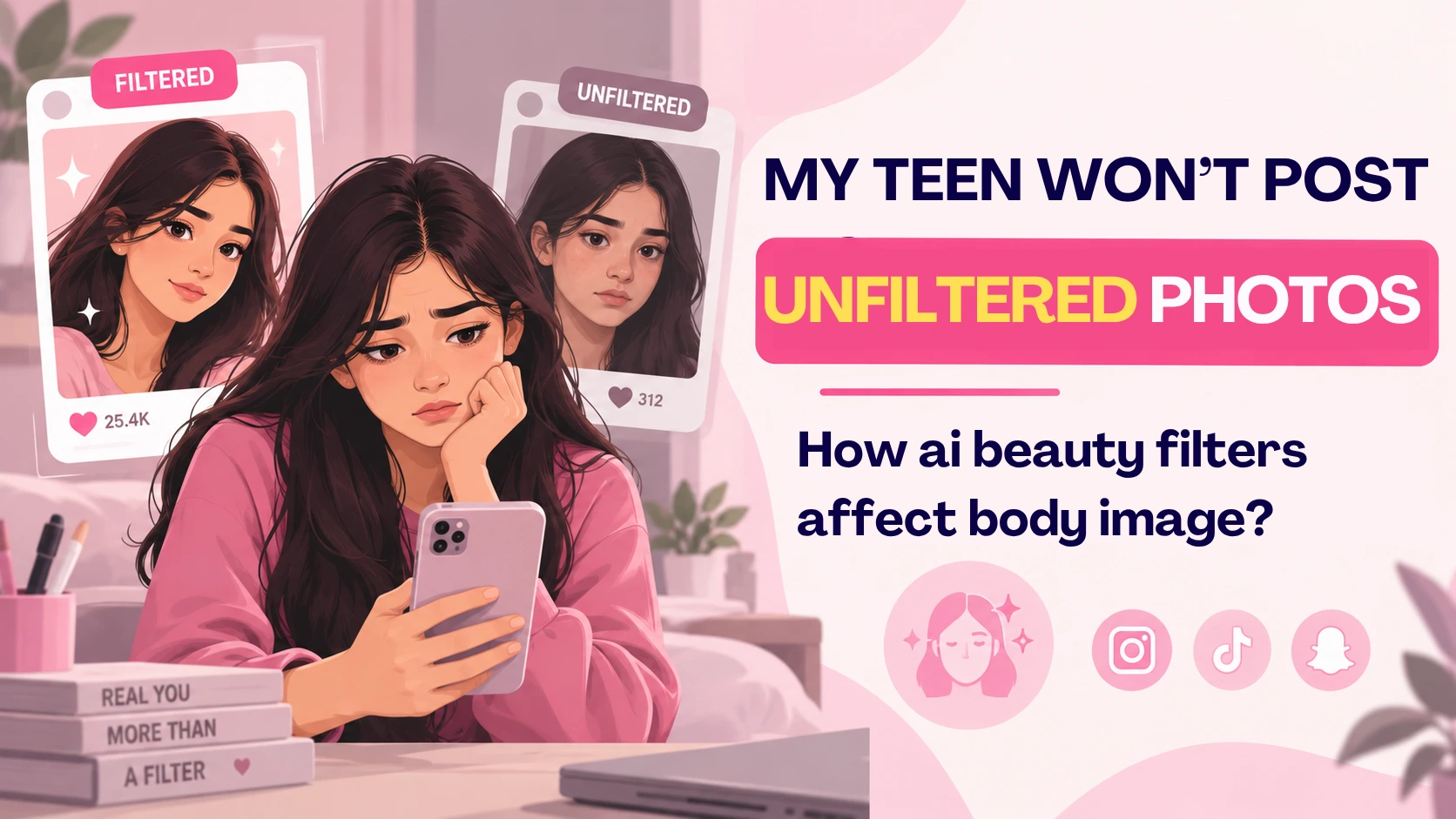
Your teen takes twenty photos, deletes nineteen, smooths their skin, changes the lighting, reshapes a feature, and then says, “I cannot post this. I look horrible.”
Many teenagers use filters playfully. Editing a photograph once in a while does not mean something is wrong. But AI beauty filters are changing the comparison a young person makes. It is no longer only “Why don’t I look like an influencer?” It can become “Why don’t I look like the edited version of me?”
Two 2026 studies involving 780 social-media users found associations between AI beauty-filter use, lower appearance self-esteem, and greater negative body-image feelings. These studies do not prove that filters cause every concern, and they were not India-specific teen-prevalence studies. Still, they reinforce an important clinical truth: repeated exposure to altered faces and bodies can make normal features feel like flaws.
Psychologist Reena Chopra of Saar Holistic Wellness advises parents to stay curious rather than critical. The goal is not to shame a teen for using a filter. It is to help them feel that their worth is not decided by a camera, a comment section, or an algorithm.
What Do AI Beauty Filters Do to a Teen’s Body Image?
Older filters often added ears, colour, or a funny effect. AI beauty tools can make changes look much more believable. They may smooth skin, narrow a nose, enlarge eyes, alter jawlines, lighten or even skin tone, change facial symmetry, remove body texture, or reshape parts of the body.
Over time, a teen may begin to see the edited image as the “better” or “real” version of themselves.
Signs of Appearance Anxiety in Teenagers
Look for a repeated pattern, not one bad photo day:
- Refusing to be photographed without a filter
- Spending long periods editing selfies
- Deleting posts because of small perceived flaws
- Seeking repeated reassurance about looks
- Comparing skin tone, weight, height, hair, or facial features with peers
- Avoiding school events, photos, video calls, or social outings
- Speaking harshly about their body or face
- Starting extreme eating, exercise, skincare, or grooming routines
- Becoming distressed by acne, weight changes, or normal puberty changes
These signs do not diagnose body dysmorphic disorder, an eating disorder, or depression. They do tell us a teen may need more support and less appearance pressure.
Why AI Filters Can Feel So Powerful for Indian Teens
Teen body image is shaped by many things: puberty, family comments, peer teasing, celebrity culture, colourism, beauty advertising, sports or academic stress, and social media.
In India, a young person may also hear casual remarks about weight, complexion, height, hair, acne, or “looking presentable” from people who do not realise the impact. A filtered feed can make those comments feel even louder.
It affects boys as well as girls. Boys may worry about height, muscles, hair, skin, or facial features, but may be less comfortable naming body-image distress.
Do not assume this is vanity. For some teens, appearance anxiety is connected to belonging, fear of judgement, bullying, or low self-worth.
How Parents Can Talk About AI Filters and Teen Self-Esteem
Avoid opening with: “You are beautiful, stop being silly.” Although loving, this can feel like the parent has not understood the pressure.
Try:
“I noticed you seem stressed after taking photos. What feels difficult about posting without a filter?”
Or:
“These apps change faces so convincingly that it can be hard not to compare. How do you feel after using them?”
Listen first. Your teen may say, “Everyone uses filters,” “My skin looks bad,” or “People will judge me.” Resist the urge to dismiss this immediately.
Then gently add perspective:
“I understand the pressure. I also want you to know that the version on screen is edited. You do not have to earn the right to be seen by looking perfect.”
Practical Ways to Support a Teen Who Hates Unfiltered Photos
1. Change the Family Language About Bodies
Avoid comments about weight gain, skin colour, food “guilt,” ageing, or needing to look thinner, fairer, taller, or more polished. This includes comments about your own body.
Try to praise qualities not based on appearance: humour, effort, courage, kindness, creativity, persistence, and values.
2. Curate the Feed Together
Ask your teen which accounts leave them feeling inspired and which leave them feeling inadequate. Encourage them to mute, unfollow, or reduce appearance-focused content that repeatedly makes them feel worse.
Do not force a “body positivity” account on them. The aim is a more balanced feed, not another standard to perform.
3. Keep Photos in Perspective
Have calm conversations about lighting, posing, editing, makeup, cosmetic procedures, and AI alterations. Teach media literacy: an image can be attractive, creative, and still not be an honest representation of everyday life.
4. Support Comfort, Not Forced Exposure
Do not insist that a distressed teen post an unfiltered selfie to “prove confidence.” Small steps are more useful. They might first keep an unedited photo privately, choose a less edited image, or take part in a non-appearance-focused activity.
5. Watch for Bullying and Body Shaming
Ask directly but gently whether anyone has made comments online or offline. If bullying is involved, save evidence, report through the platform or school process, and focus on your teen’s safety rather than telling them to ignore it.
When Filter Use May Need Professional Support
Consider professional help when appearance worries are persistent or begin to limit a teen’s life. Seek support if your teen:
- Avoids school, friends, photos, or activities because of appearance fear
- Is restricting food, bingeing, purging, over-exercising, or using unsafe products
- Has frequent panic, sadness, or anger about their looks
- Checks mirrors or edits photos compulsively
- Has been bullied, sexually harassed, or targeted by a deepfake
- Talks about self-harm, hopelessness, or not wanting to live
If your teen mentions self-harm, suicide, or immediate danger, seek urgent local emergency or mental-health support. In India, call 112 in an emergency.
A qualified professional can explore the whole picture like confidence, anxiety, body-image concerns, bullying, mood, eating patterns, and family pressures, without reducing your teen to a diagnosis.
Research Sources for Publishing
- Two 2026 studies of 468 and 312 social-media users respectively reported associations between AI beauty-filter use, negative body-image states, fear of appearance evaluation, and lower appearance self-esteem. 1
- Indian reporting in 2026 summarised clinical concerns about filters, curated feeds, self-comparison, body dissatisfaction, and teen self-esteem. 2
- A research review discusses both potential positive and negative associations between social media and body-image perception in young people. 3
Your teenager does not need to love every photograph of themselves. They do deserve a life that is bigger than worrying about one.


