
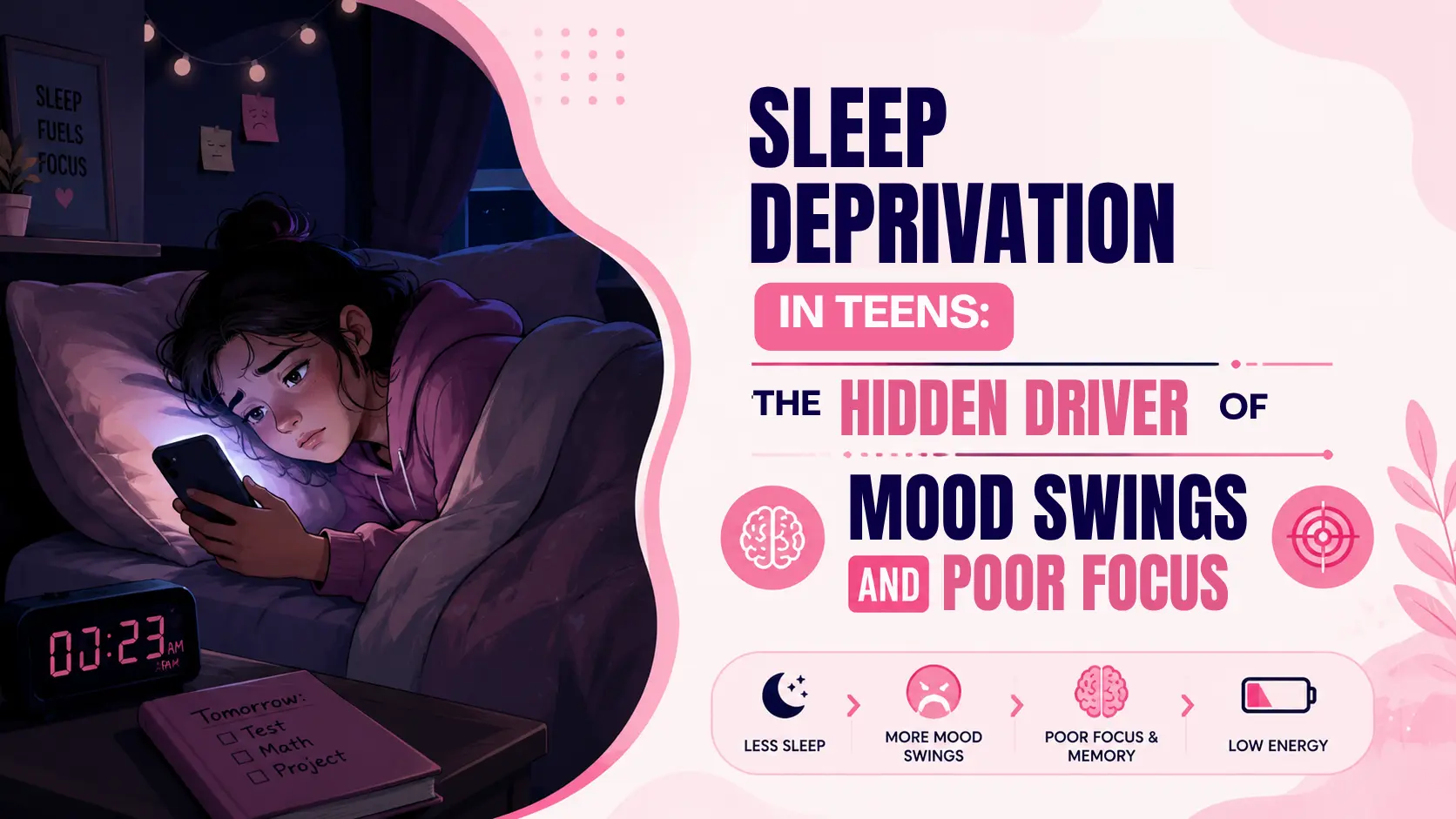
Nearly 8 out of 10 high schoolers, 77% according to the CDC, are not getting the sleep their growing brains and bodies need on an average school night. In my clinic, when I ask parents to describe their teenager in one word, “moody” comes up more than almost anything else. What most don’t realise is that the real culprit sitting quietly behind the mood swings, the snapping at siblings, and the “I can’t focus, I don’t know what’s wrong with me” is often something far simpler than a mental health diagnosis: sleep deprivation in teens.
I’ve spent nearly two decades working with families across India and internationally, and one thing I’ve learned is that we tend to treat teenage sleep as optional, squeezed out by late-night coaching classes, WhatsApp group chats that never seem to sleep, and the belief that “she can catch up on weekends.” But sleep isn’t a luxury for a teenage brain. It’s when the emotional regulation system actually gets repaired.
I once worked with a family who had brought their sixteen-year-old to me convinced she was developing an anxiety disorder. She was tearful most evenings, short-tempered with her younger brother, and struggling to sit through a single homework session without losing focus. When we mapped out her week, the picture became clear: coaching until 8:30 pm, dinner and homework until past midnight, and a 6 am alarm for school, five days a week. She wasn’t anxious. She was running on four to five hours of sleep, night after night, and her brain simply couldn’t regulate itself anymore. Within three weeks of protecting her sleep, most of what looked like anxiety had genuinely eased.
What Happens When a Teenage Brain Doesn’t Sleep Enough
Teenagers need 8 to 10 hours of sleep a night, not because they’re lazy, but because adolescence is a period of intense brain development, particularly in the prefrontal cortex, the part responsible for emotional control, decision-making, and focus. When that development is interrupted night after night, the effects show up almost immediately.
Studies on sleep-deprived high schoolers show measurable spikes in tension, low mood, and fatigue, alongside a sharp drop in energy and motivation, sometimes after just one or two nights of reduced sleep. Cognitively, the effects are just as real: attention, memory, and reaction time all take a hit, which is precisely why a teenager can study for hours and still forget what they read the next morning.
The India-Specific Sleep Trap
If you’re raising a teenager in India, or within an Indian family abroad, this problem often has a very specific shape. Board exam years turn late nights into a badge of honour. Coaching classes stretch the day well past 8 pm. And it’s common, even quietly expected, for a teenager to be finishing homework or scrolling until well past midnight, only to wake at 6 am for school or tuition the next day.
I often tell parents: a child who sleeps 5 hours and studies 10 will remember less than a child who sleeps 8 and studies 7. Sleep isn’t time taken away from academics, it’s when the brain files away everything learned that day. Cutting it short doesn’t create more hours for success; it quietly erodes the ones already spent. I’ve watched bright, hard-working students plateau not because they weren’t capable, but because their brains simply never got the rest needed to consolidate what they’d learned.
Signs the Mood Swings Might Actually Be Sleep
Before assuming a mood or behaviour problem is purely emotional, it’s worth asking: has my teen been sleeping enough this week? Watch for:
- Irritability or tearfulness that feels disproportionate to what triggered it
- Difficulty concentrating on homework or even everyday conversations
- Falling asleep during the day, whether in class, at meals, or on car rides
- Increased reliance on caffeine, such as energy drinks or extra cups of chai or coffee
- Getting “a second wind” late at night, which makes bedtime even harder
If several of these sound familiar, sleep is worth addressing first, before jumping to other explanations for the mood changes you’re seeing. In my experience, parents are often surprised by how much shifts, including mood, patience, and even the tone of family dinners, once sleep alone is corrected, without a single other change being made.
What Actually Helps, Without a Daily Battle
I know the bedtime fight is exhausting for both of you, so here’s what I recommend to the families I work with:
Set a “device sundown,” not just a bedtime. Ask your teen to put their phone outside the bedroom, or at least on silent, 45 minutes before sleep, since the blue light and social scrolling delay the brain’s natural wind-down process.
Protect a consistent wake time, even on weekends. Wildly different sleep schedules on weekdays versus weekends confuse the body’s internal clock more than most families realise, making Monday mornings even harder.
Involve them in the “why,” not just the rule. Teenagers respond far better to “your brain needs this to actually remember what you study” than to “because I said so.”
Look at coaching and tuition schedules honestly. If your child is consistently sleeping less than 7 hours because of academic commitments, it may be worth having a candid conversation with the coaching centre, or reconsidering the overall load.
When Poor Sleep Points to Something More
Sometimes sleep struggles aren’t just about screens or schedules. They can be tied to anxiety, low mood, or stress your teenager hasn’t put into words yet. If your child’s sleep hasn’t improved despite consistent effort at home, or the mood changes feel bigger than tiredness alone can explain, it may help to bring in someone who can look at the full picture with fresh eyes.


