
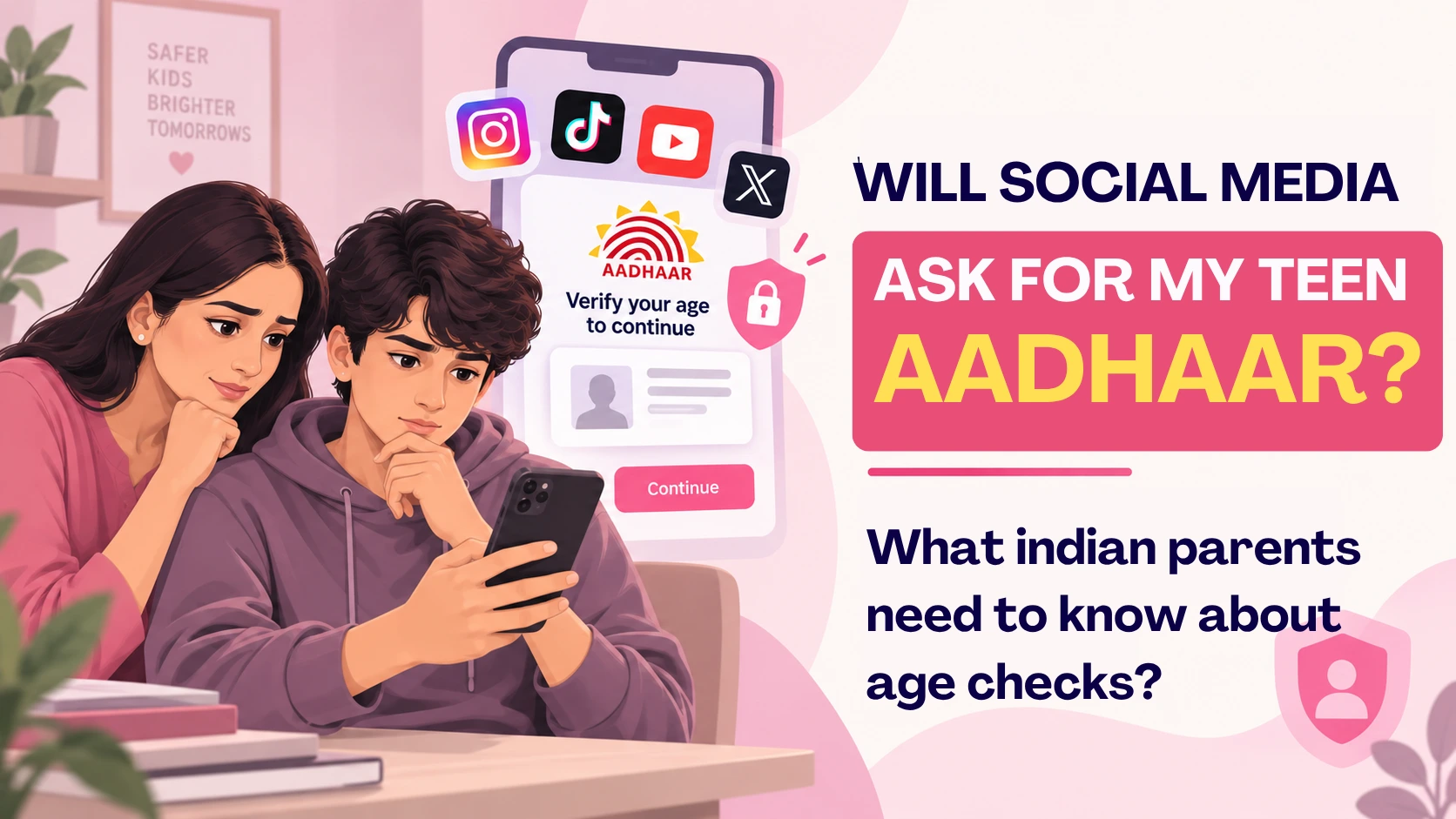
“Will my child need Aadhaar to use Instagram?” “Will social media be banned for teenagers?” “Do I have to give a platform my documents to keep my child safe?”
These are understandable questions as India debates stronger online safeguards for children and teenagers.
On 10 September 2026, a three-judge Supreme Court bench issued notice to the Union government on a petition seeking stronger safeguards for minors using social-media platforms. The issue is active and evolving. Headlines can move faster than the law.
Here is the most important point for families: as of this writing, India does not have a blanket nationwide law that bans all teenagers from social media or requires every child to submit Aadhaar to open an account. Do not rely on viral posts claiming otherwise.
Psychologist Reena Chopra of Saar Holistic Wellness encourages a balanced response: keep informed, protect privacy, use available account settings, and talk openly with your teen. An age gate is not a substitute for trust, digital literacy, or a relationship where a child can ask for help.
What Does Social Media Age Verification in India Mean?
Age verification means a platform tries to determine whether a user is a child, teenager, or adult so it can apply age-appropriate protections.
Different methods may be discussed or tested, including:
- A date of birth entered by the user
- Parent or guardian consent
- An age-estimation system
- A document or digital-age token
- A third-party verification service
These are not all equally private, accurate, or available. A proposed policy is not the same as a final rule, and a company test is not the same as a legal requirement.
Does India Require Aadhaar for Teen Social-Media Accounts?
Not as a universal, final rule.
India’s Digital Personal Data Protection Act, 2023 says that a platform processing a child’s personal data must obtain verifiable parental consent. The exact method of verifying that consent is a major policy and privacy question. Public debate has included possibilities such as DigiLocker-linked proof or privacy-preserving age tokens, but that does not mean every family must currently upload Aadhaar for every app.
Before sharing a child’s or parent’s identity document, check the platform’s official notice and the current legal position. Do not click a document-upload link sent through an unsolicited SMS, WhatsApp message, email, or pop-up.
Why Is India Discussing Age Checks for Social Media?
Parents, educators, courts, child-safety groups, and policymakers are concerned about real online risks, including:
- Cyberbullying and harassment
- Sexual exploitation, grooming, sextortion, and non-consensual image abuse
- Exposure to age-inappropriate content
- Fake accounts and impersonation
- Compulsive or late-night use
- Data profiling and targeted advertising
- Harmful challenges, gambling-like features, and misinformation
At the same time, teenagers use digital spaces for schoolwork, hobbies, friendships, creative work, community, and information. A sensible approach must protect children without treating every online interaction as harmful.
The Benefits and Limits of Teen Account Protections
Many platforms now offer teen-account features such as private-account defaults, stricter messaging controls, sensitive-content settings, time reminders, and parent-supervision tools.
These can be useful. They can reduce unwanted contact or make risky settings less visible.
But they cannot guarantee that a child will not encounter bullying, pressure, explicit content, scams, or unsafe people online. A child can be contacted through another app, a group chat, a game, or a peer’s account.
Use platform tools as one layer of safety not as proof that a teen is fully protected.
How Parents Can Talk About Age Checks Without Making Teens More Secretive
A conversation about online rules can quickly become a fight about trust. Try to start with curiosity.
You could say:
“There are changes being discussed about teen accounts and privacy. I am not interested in spying on you. I want us to know how to keep your information safe and what to do if something feels wrong.”
Then ask:
- “Which apps matter most to you, and why?”
- “Do you know who can message you, tag you, or add you to groups?”
- “Would you know what to do if someone asked for a photo, money, or a secret chat?”
- “Which settings would make you feel safer without making you feel watched?”
A teen is more likely to disclose a problem when they believe the first response will be help not blame or immediate confiscation.
A Family Checklist for Teen Social-Media Safety in India
1. Review Privacy Settings Together
Check who can view posts, message your teen, tag them, see their location, add them to groups, or download/remix their content. Private accounts can reduce exposure, though they cannot eliminate screenshots or sharing by known contacts.
2. Keep School and Location Details Limited
Avoid posting school IDs, timetables, home addresses, live locations, phone numbers, or travel plans publicly. A uniform photograph or school event post can reveal more than families realise.
3. Use Two-Factor Authentication
Help teens use strong, unique passwords and two-factor authentication. They should never share passwords, OTPs, or account logins with a friend to “prove” trust.
4. Make a No-Blame Reporting Promise
Say this clearly:
“If anyone threatens, bullies, blackmails, or makes you uncomfortable online, tell me. You will not be in trouble for asking for help.”
This is one of the most protective messages a parent can give.
5. Discuss Consent and Forwarding
Teach teens not to share, forward, joke about, or comment on another person’s private, sexualised, edited, or humiliating image even if the image is fake or appears in a “private” group.
6. Keep Parent Controls Proportionate
Younger children may need more direct supervision. Older teens need growing privacy and autonomy, alongside clear safety boundaries. Discuss what information a parent can see, when checks will happen, and what circumstances would require more intervention.
What to Do if Your Teen Encounters Online Harm
If there is cyberbullying, sexual-image pressure, blackmail, impersonation, grooming, or a threatening message:
- Stay calm and believe your teen. Say, “You are not in trouble. We will handle this together.”
- Preserve essential evidence such as user names, URLs, dates, threats, and report confirmations. Do not circulate harmful images.
- Report the account or content on the platform.
- Use India’s National Cyber Crime Reporting Portal: cybercrime.gov.in. The cybercrime helpline is 1930.
- Contact the school if classmates or school groups are involved, and ask for a confidential safeguarding response.
- Seek emotional support if your teen is ashamed, frightened, withdrawing, avoiding school, or showing signs of anxiety or low mood.
If there is immediate danger, self-harm risk, or a threat of physical harm, call 112 or seek urgent local support.
Research and Official Sources for Publishing
- The Supreme Court issued notice to the Centre on 10 September 2026 in a matter seeking stronger safeguards for minors using social-media platforms. Read More…
- India’s Digital Personal Data Protection Act, 2023 requires verifiable parental consent before a data fiduciary processes a child’s personal data. Read More…
- India’s official reporting portal for cybercrime: cybercrime.gov.in.
Online safety is not achieved by one app setting, one age check, or one difficult conversation. It grows when children know that their privacy matters and that they can come to an adult before a problem becomes bigger.


