
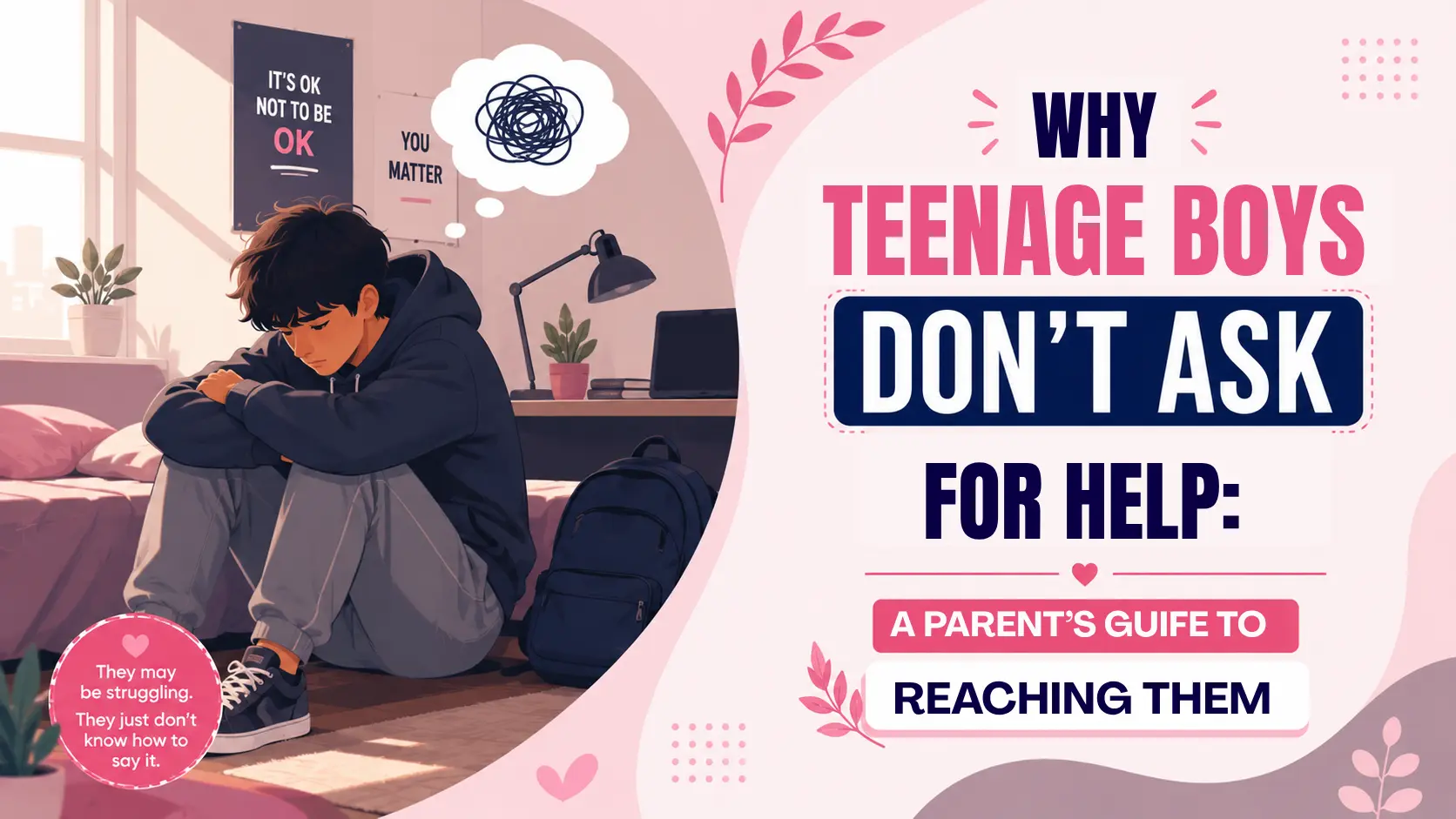
In my seventeen years as a child psychologist, one sentence comes up more than almost any other, usually from an exhausted, worried mother sitting across from me: “He used to tell me everything. Now I don’t know what’s going on in his head.” If you’re here because you’re asking yourself why teenage boys don’t ask for help, I want you to know first that you are not imagining this, and you are not doing anything wrong.
The numbers back up what I see every week in my practice. In the UK, young men aged 18 to 25 make up less than 30% of referrals to psychological therapy services, even though their struggles are just as real as their female peers’. Closer to the age group we’re talking about here, researchers have found that nearly 3 in 10 teenagers admit they delay or avoid seeking mental health support because they’re afraid of being judged. For boys, that fear tends to run even deeper.
Here’s what I’ve come to understand after sitting with hundreds of teenage boys and their families: silence is not the absence of struggle. It’s often the loudest sign of it.
I remember a mother who came to me convinced her fifteen-year-old had simply “grown distant,” the way teenagers do. What we uncovered together, over a few sessions, was a boy who had been carrying exam anxiety and a painful friendship breakup alone for months, not because he didn’t want his mother’s comfort, but because he genuinely didn’t know how to start that conversation, and worried it would make him seem weak in front of her. He wasn’t avoiding her. He was protecting an image he thought he had to maintain. This is far more common than most parents realise.
Why Teenage Boys Don’t Ask for Help, Even When They’re Struggling
From a young age, many boys are handed an unspoken rulebook: don’t cry, don’t complain, don’t need anyone. In Indian households especially, this message often arrives wrapped in love, through a grandfather’s “mard ko dard nahi hota” (men don’t feel pain), an uncle laughing off a nephew’s tears, or a father who never once said “I was scared too.” Nobody intends harm by it. But the lesson lands anyway: strong means silent.
Research supports this pattern. A 2023 study published in Child and Adolescent Psychiatry and Mental Health found that boys are far more likely to underreport what they’re feeling. Instead of naming sadness or anxiety, they act it out through anger, irritability, or sudden distance. Parents see the behaviour. They rarely see the feeling underneath it.
Add to this the quiet pressure of being “the responsible one,” the son who will one day carry the family’s name and expectations, and you get a teenage boy who has learned, often without a single direct conversation, that his job is to hold it together, not talk about falling apart.
The Signs Parents Often Miss
Because boys rarely say “I’m struggling,” parents have to learn to read what’s underneath. In my practice, I ask mothers to gently watch for:
- A sudden drop in things he used to enjoy, such as cricket, friends, music, or even the usual sibling bickering
- Irritability that feels out of proportion, since snapping over small things is often distress wearing anger’s clothing
- Withdrawing into his room, headphones, or screen for far longer stretches than before
- “I’m fine” said a little too quickly, a little too often
- Changes in sleep or appetite with no obvious explanation
None of these, on their own, mean something is seriously wrong. But a cluster of these changes lasting more than two weeks is worth gently paying attention to.
I often remind parents that boys are especially skilled at what I call “performing okay,” meaning he shows up to school, cracks jokes with friends, and finishes homework on time, all while quietly carrying something heavy underneath. This is partly why report cards and outward behaviour alone are unreliable indicators of how a teenage boy is really doing. The mask can hold for months, right up until it doesn’t.
What Actually Helps a Teenage Boy Open Up
If you’ve tried sitting your son down for The Big Conversation and been met with a shrug, you’re not alone, and you’re not failing him. Direct, face-to-face questioning can feel like an interrogation to a teenage boy, and it usually shuts him down faster than it opens him up.
What works instead, in my experience:
Talk beside him, not at him. Some of the most honest conversations happen during a car ride, while cooking together, or on a walk, basically anywhere eye contact isn’t mandatory.
Ask about a friend before you ask about him. “Does anyone in your group seem stressed lately?” often opens a door that “Are you okay?” closes.
Resist the urge to fix immediately. When he does share something, the fastest way to make him regret it is to jump straight into solutions or lectures. Try “That sounds really hard” before anything else.
Model it yourself. If you want your son to believe that talking about feelings isn’t weakness, he needs to see the adults around him do exactly that, including, sometimes, admitting your own bad days out loud.
When It’s Time to Bring In Extra Support
Sometimes, what a teenage boy needs is more than home conversations alone can offer, and that is not a reflection of your parenting. Just as we don’t hesitate to hire a coach when a child is serious about cricket or preparing for board exams, therapy is simply skilled, structured support for the mind. Framing it this way, as training rather than treatment for something “wrong” with him, often makes boys far more willing to try it.
If your son has pulled away for weeks rather than days, if his grades, sleep, or friendships are visibly slipping, or if you sense something he isn’t saying, it’s worth having a professional in his corner.
You Don’t Have to Figure This Out Alone
Understanding why teenage boys don’t ask for help is the first step. The second is knowing you don’t have to be the only one reaching out to him. In my practice, I work with parents to build the kind of trust that makes a teenage son feel safe enough to talk, and to make sure that when he’s ready, someone is there to listen without judgment.


