
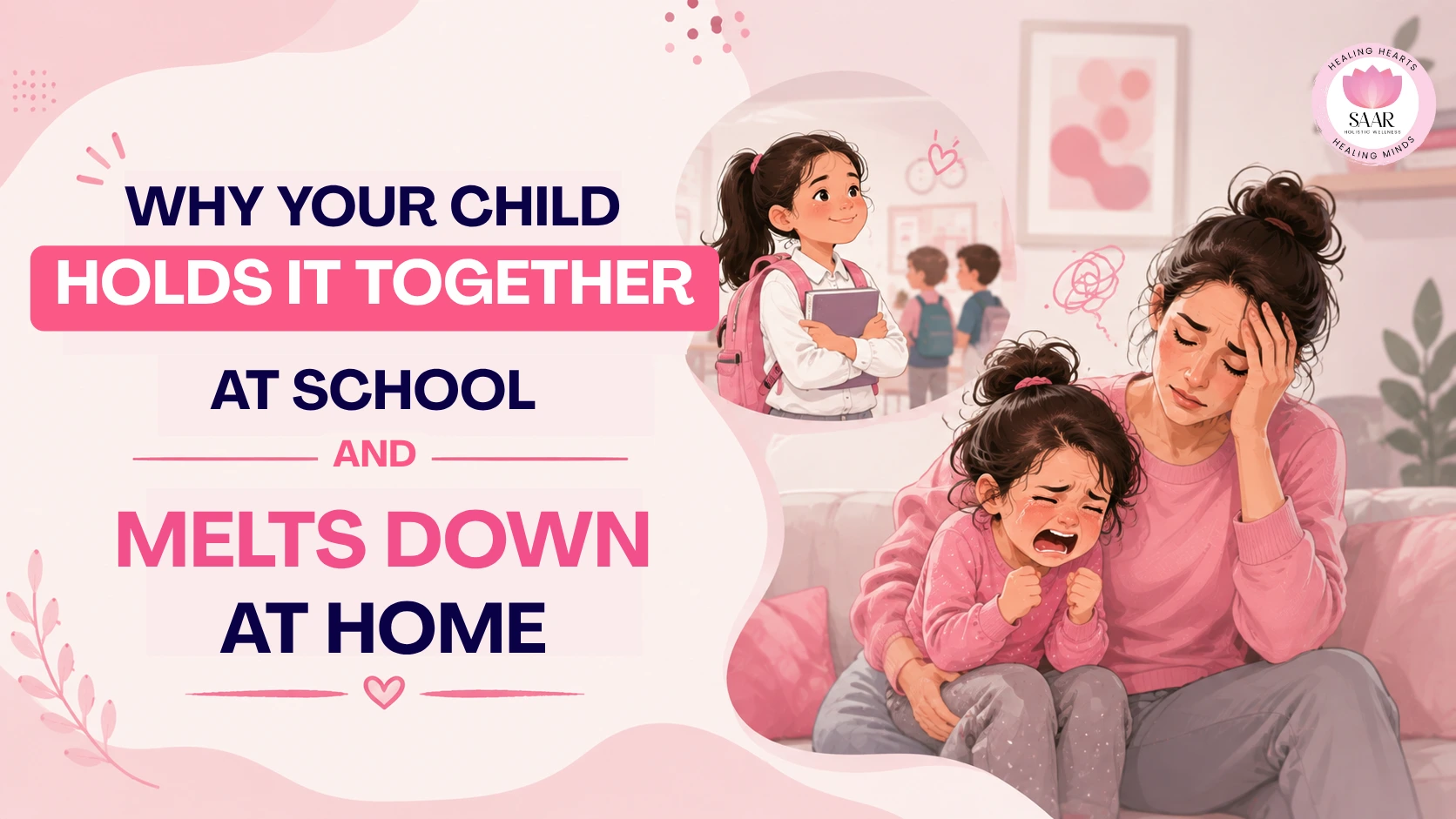
“Your child is so well behaved in school.”
Many parents hear this from teachers and feel confused. Because by 4 pm, the same child may be crying, shouting, throwing their bag, fighting with a sibling, refusing homework, or saying, “Don’t talk to me!”
You may wonder: How can my child behave perfectly at school and fall apart only with me?
A 2026 study that followed 747 children found patterns suggesting that self-regulation becomes harder to sustain as the school day goes on. Children spend hours following rules, managing noise, learning, socialising, waiting, sharing, and trying to meet expectations. By the time they reach home, their emotional energy may be very low.
Psychologist Reena Chopra often reminds parents: your child may be falling apart at home because home feels safe enough to stop holding everything in.
That does not make the behaviour easy. It does mean the answer is usually not more anger, criticism, or punishment.
What Is an After-School Meltdown?
An after-school meltdown is when a child becomes emotionally overwhelmed after school or daycare. It may happen during pickup, in the car, just after coming home, or when homework begins.
Some people call this after-school restraint collapse. It is not a formal medical diagnosis. It is a useful way to describe a pattern many parents notice: a child manages all day, then releases the built-up stress in their safest space.
An after-school meltdown may look like:
- Crying over a small request
- Angry shouting or rude words
- Throwing the bag or school materials
- Fighting with siblings
- Refusing food, bath time, or homework
- Wanting to be left completely alone
- Becoming very clingy
- Complaining of headache, stomach ache, or tiredness
- Saying “I hate school” without explaining why
The behaviour may be big, but the message underneath is often simple: “I have had enough.”
Why Does My Child Behave at School but Not at Home?
School requires constant self-control. Children may need to:
- Sit still for long periods
- Follow many instructions
- Stay quiet when they want to talk
- Share space and materials
- Manage friendships and peer pressure
- Cope with noise, crowds, and transitions
- Keep up with lessons
- Hide worry, sadness, or confusion
For a child with ADHD, anxiety, sensory sensitivities, learning differences, or social stress, these demands can feel even heavier.
At home, they may finally release the feelings they could not express at school.
This is not proof that your child respects school more than you. It can be proof that they feel safest with you.
Is an After-School Meltdown the Same as a Tantrum?
They can look similar, but the reason behind them may be different.
A tantrum often happens because a child wants something or is frustrated by a limit. An after-school meltdown is more likely to happen because the child is emotionally and physically depleted.
During a meltdown, reasoning may not work well. Your child may not be able to explain what is wrong or respond to lectures.
Instead of asking, “Why are you behaving like this?” try noticing the pattern:
- Does it happen more on certain school days?
- Is your child hungry or thirsty?
- Did they have an exam, difficult class, or friendship issue?
- Was the school day noisy or crowded?
- Does the meltdown begin when homework starts immediately?
- Is your child sleeping enough?
Behaviour has context. Looking for that context is more useful than labelling the child.
Common Causes of After-School Meltdowns
Hunger and Low Energy
Many children come home hungry, tired, and dehydrated. A rushed lunch, a long bus ride, sports practice, or a hot day can make emotions harder to manage.
Offer water and a filling snack before asking questions about school.
Too Many Questions at Pickup
Parents naturally want to know, “How was school? What did you learn? Did you eat lunch?”
But some children need silence first. Talking may feel like one more demand after a full day of listening and responding.
Try a gentle welcome instead:
“I am happy to see you. We can talk whenever you are ready.”
Social Stress
Friendship problems can drain a child deeply. A child may have been left out, corrected by a teacher, teased, embarrassed, or worried about fitting in.
They may not have the words for it until later.
Academic Effort
A child may appear fine in class while working very hard to keep up. When the school day ends, the exhaustion appears.
This can be especially common in children with attention challenges, learning differences, or perfectionism.
Sensory Overload
A classroom can be loud, bright, crowded, and unpredictable. Noise, bells, uniforms, smells, physical closeness, and transitions can overwhelm some children.
For them, the homecoming meltdown may be a sign that their sensory system needs a reset.
How to Handle After-School Meltdowns Without Making Them Worse
Give Them a Decompression Window
For the first 20 to 30 minutes after school, try to reduce demands.
This may mean:
- A quiet car ride
- A snack and water
- Music, drawing, reading, or free play
- Time alone in a calm space
- Outdoor movement
- A cuddle, if the child wants one
Connection before correction is often the most helpful first step.
Keep Questions Light
Instead of asking for a full report, try one small question later:
- “What was one okay part of your day?”
- “Was anything difficult today?”
- “Do you want to talk, draw, or just relax?”
Do not force a conversation. Your calm availability matters more than getting an immediate answer.
Delay Homework When Possible
For many children, sitting down for homework immediately after school can trigger an after-school meltdown.
Give a planned break first. Let your child eat, rest, move, and reset. Then agree on a simple homework time.
A visual plan can help:
- Snack and rest
- Homework for 20 minutes
- Five-minute break
- Finish one small task
Avoid Long Lectures During a Meltdown
A child in emotional overload cannot learn from a long explanation.
Keep your voice low. Use fewer words. Focus on safety.
You can say:
“You are having a hard moment. I am here. We will talk when your body feels calmer.”
If your child is hitting, throwing, or hurting someone, set a clear boundary:
“I will not let you hurt me or your sister. I am moving back until we are safe.”
Calm boundaries are stronger than angry reactions.
A Simple After-School Routine for Emotional Regulation
Every child is different, but a predictable routine can make afternoons easier.
Step 1: Welcome Without Pressure
A smile, water, and a simple “I am glad you are home” can be enough.
Step 2: Food and Hydration
Offer a snack with protein and energy, such as fruit with nuts, yoghurt, egg, chana, paneer, or a sandwich, based on your child’s needs and preferences.
Step 3: Movement or Quiet Time
Some children need to run, cycle, dance, or jump. Others need a dim room, soft music, drawing, or silence.
Ask yourself: Does my child need to move, connect, or withdraw for a while?
Step 4: One Small Connection Moment
This could be ten minutes of a board game, a walk, folding clothes together, or sitting nearby while your child draws.
Connection does not always need a serious conversation.
Step 5: Homework and Evening Routine
Once the child is more settled, move into homework and other responsibilities in smaller steps.
When After-School Meltdowns Need More Support
Occasional emotional release after school can be normal. But it is worth seeking support if the meltdowns are:
- Happening almost every day for weeks
- Becoming more intense or unsafe
- Linked with school refusal
- Accompanied by panic, sadness, sleep changes, or physical complaints
- Affecting friendships, learning, or family life
- Connected to bullying, fear of a teacher, or academic struggles
- Present alongside ADHD, anxiety, sensory challenges, or learning difficulties
A child who is struggling after school may also be struggling during school even if they appear quiet.
Talk with your child’s teacher and school counsellor. Share what you are seeing at home. A supportive school-parent conversation can reveal patterns that neither side can see alone.
Research Sources for Publishing
- The term “after-school restraint collapse” describes a common observed pattern, but it is not a formal medical diagnosis; experts link it to sustained self-control and emotional effort during the school day. Read More…
- A 2026 report describing research that followed 747 children noted that behavioural self-regulation can become harder to sustain as the school day progresses. Read More…
- Child-development experts recommend reducing demands after school, addressing hunger and fatigue, and responding calmly when a child is emotionally overwhelmed. Read More…
Your child is not necessarily saving their “worst behaviour” for you. They may be saving their most exhausted feelings for the place where they feel safest.


