
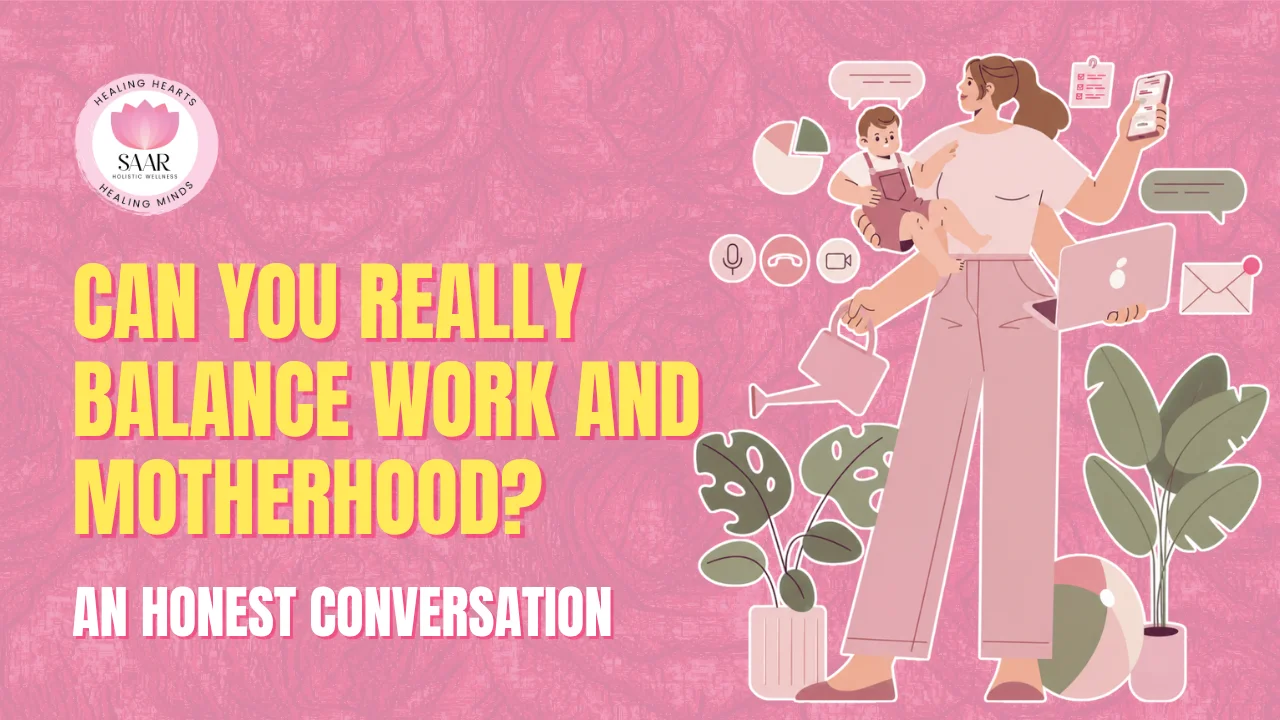
According to a 2022 survey, more than 40% of working mothers have been diagnosed with anxiety, depression, or both, a number that quietly tells the story of millions of women trying to hold everything together, all at once. (Source: Talkspace Business)
I know this not just as a child psychologist. I know it because I have lived it.
Before I became a child psychologist, a parenting coach and founded Saar Holistic Wellness, I spent years working in HR at a corporate company. I loved my work. I was good at it. And then I had a baby.
And everything I thought I knew about managing life schedules, priorities, performance, everything fell apart in the most beautiful and exhausting way possible.
The mornings were chaotic. Half-eaten breakfasts. A heart that quietly broke a little every single day, even while handing my son over to his grandmother or his nanny, people who loved him, people I trusted completely. I knew he was safe. I knew he was cared for. And yet, there was this ache that never quite went away because he needed me, and I was the one walking out the door.
I would rush to meetings while mentally still at home, wondering if he had eaten properly, if he was crying, if he was missing me the way I was missing him.
The evenings weren’t much better. I was physically present, but mentally I was still somewhere between an unread email and an unfinished task. My body was home. My mind wasn’t.
It became such an overwhelming mess that many women simply leave their jobs, believing that being home full-time will fix it. That finally having enough time will bring back the peace. And for a while, it feels that way. But honestly? Leaving doesn’t always solve it either. The guilt just shifts shape. The question stops being “Am I present enough?” and quietly becomes “Did I give up too much of myself?”
The Work-Life Balance for Working Mothers Myth We Were Never Warned About
We were sold a version of balance that simply does not exist.
Balance, in the way it is popularly described, suggests that work and motherhood can be kept neatly equal on two sides of a scale, perfectly level, every single day. But any mother who has tried to live that way knows: it is an exhausting illusion.
Some days, your child needs you more. Some weeks, a project deadline pulls you away. Some seasons of life are heavier than others. Demanding that everything stay “balanced” at all times is not a standard, it is a trap.
And yet, we keep chasing it. We keep measuring ourselves against it. We keep feeling like we are failing when, honestly, we were never given a fair shot at succeeding.
What I Saw in My Practice and What I Felt in My Own Life
In my 17 years of working with families, I have sat across from hundreds of mothers who are brilliant, devoted, deeply loving and completely burned out.
They come to me with questions about their child’s behaviour or emotional struggles. But within a few sessions, something else always surfaces: “I feel like I am never enough. Not at work. Not at home. Not anywhere.”
Research backs up what I see in my practice every day. Studies on working mothers in India specifically show that family-work guilt significantly affects job satisfaction and that in our collectivist culture, caregiving is not only expected but also highly valued, meaning any perceived shortfall triggers feelings of guilt, shame, and inadequacy.
I felt all of that myself during my corporate years. I remember sitting in a performance review, being told I had great potential while in my head, I was calculating whether I had enough time to pick up my child from the creche before it closed. That duality is exhausting in a way that is hard to explain to someone who has not lived it.
What I eventually understood both personally and professionally is that guilt is not a sign that you are doing something wrong. It is a sign that you love deeply. But love does not have to come at the cost of your mental and emotional wellbeing.
What the Research Says About Working Mother Burnout
The numbers are hard to ignore.
More than 40% of working mothers have been diagnosed with either anxiety, depression, or both. The demands of children and home life, coupled with high professional expectations, leave many mothers caught in a relentless cycle of stress that is genuinely difficult to escape.
In India, the picture is even more layered. Research involving 560 Indian working mothers found that family-work guilt directly affected job satisfaction. The emotional weight of feeling like you are falling short at home bleeds into how you show up professionally.
And it goes the other way too. Due to what researchers call “cultural mothering,” mothers feel guilty for not being able to spend enough time with their children or for not giving 100% to their job. This creates a sense of burnout that negatively affects mental health and overall wellbeing.
This is not a personal failing. This is a systemic pressure that millions of mothers are carrying alone, in silence, while still showing up every single day.
How to Manage Work and Family as a Mother Starting With Letting Go of “Balance”
The first shift I invite the mothers I work with to make is a linguistic one: stop trying to “balance” work and motherhood, and start thinking about integration.
Integration acknowledges that you are one whole person not two people playing two separate roles. Your work does not have to be at war with your motherhood. They can coexist, with some thoughtfulness and a lot of compassion toward yourself.
Here is what that has looked like in my own life and in the lives of the mothers I support:
Presence Over Perfection in Managing Motherhood and Career
You do not need three hours with your child every evening. You need twenty minutes where you are fully there, phone away, work brain switched off, genuinely present. Children feel the quality of your attention far more than they clock the quantity.
Seasons, Not Scales A Conscious Parenting Approach for Working Moms
There will be seasons where work demands more. There will be seasons where your child needs more. Allow yourself to lean into each season without guilt knowing that over time, the love and effort you are giving balances out in ways that matter.
Working Mother Burnout Starts With Ignoring Your Own Needs
You cannot pour from an empty cup. This is not a cliché, it is neuroscience. A chronically depleted mother is not a more devoted mother. Rest, support, and occasional solitude are not luxuries. They are maintenance.
For the Mom Standing at a Career Crossroads
If you are reading this while sitting with a decision whether to return to work, step back from a demanding role, or make a career shift after having a child I want to say something gently but clearly:
There is no universally right answer.
Leaving work does not make you a better mother. Staying at work does not make you a worse person. What matters far more than the decision itself is the emotional environment you create at home and that is something you can shape regardless of your employment status.
What I do encourage is making that decision from a place of clarity, not guilt. Not because society expects something of you. Not because you are trying to prove something. But because you have sat with it, understood your own needs, and chosen what genuinely serves your family including you.
If you are finding it hard to access that clarity, that is completely okay. It is exactly what I am here to help you find.
You Don’t Have to Figure Out Work-Life Balance for Working Mothers Alone
The mothers I have seen truly thrive, not just cope, are not the ones who found perfect balance. They are the ones who stopped demanding perfection from themselves and started asking for support instead.
Whether you are struggling with working mom guilt, navigating a career decision after having a child, or simply feeling stretched too thin you do not have to carry this alone.


