The Question I Hear Most Often
In my 17 years as a child psychologist and parenting coach, the question I hear most often from new and newer mothers is not about sleep schedules or toddler behaviour. It’s a quieter, more unsettling question and it usually comes out haltingly, sometimes tearfully, often with a look of embarrassment:
‘Why don’t I feel like myself anymore?’
Research gives us some context for how significant this experience is. A 2024 study published in Frontiers in Psychiatry found that matrescence, the profound psychological, social, cultural, and existential transformation that occurs as women become mothers remains critically under-recognised in both clinical practice and public conversation. Despite the fact that motherhood is one of the most universal human experiences, we have, until very recently, lacked even a common language for what it actually does to a woman.
I want to give you that language today. Because once you have the word, so much of what you’ve been quietly suffering through starts to make sense.
What Is Matrescence?
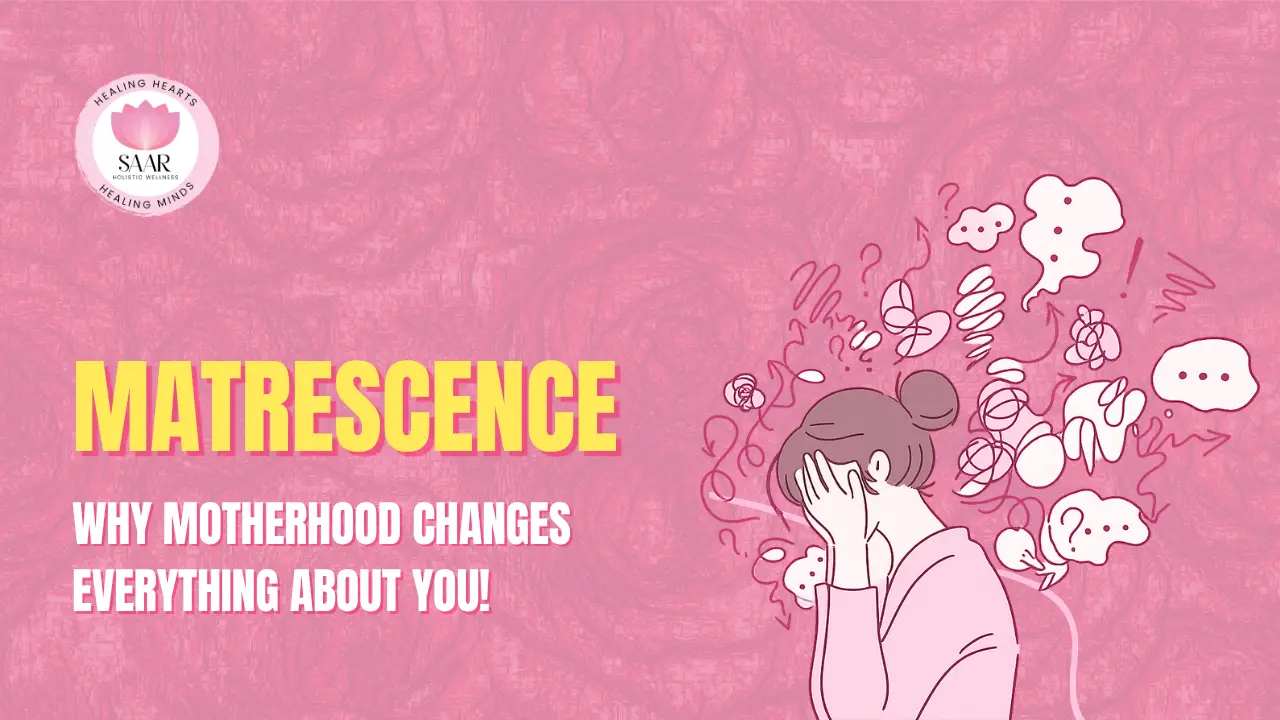
Matrescence (pronounced mah-treh-sense) is a term first coined by medical anthropologist Dana Raphael in 1973 and significantly expanded in recent years by perinatal psychiatrist Dr. Aurelie Athan at Columbia University. It describes the developmental passage a woman moves through when she becomes a mother encompassing the biological, psychological, relational, and existential changes that this transition brings.
Think of it as the mother’s equivalent of adolescence. Just as adolescence is not simply a hormonal inconvenience between childhood and adulthood, but a genuine developmental stage with its own brain changes, identity work, and emotional turbulence matrescence is a developmental stage with its own profound reshaping of who a woman is and how she exists in the world.
| Just as we don’t tell teenagers to ‘snap out of’ adolescence, we should stop expecting mothers to simply ‘adjust’ to motherhood. Matrescence is a developmental passage and it deserves to be treated as one. |
What Matrescence Does to Your Brain
This part, I find, is both the most surprising and the most comforting for mothers to hear: becoming a mother physically changes your brain.
Research published in Trends in Cognitive Sciences (available via PubMed Central) shows that the transition to motherhood is marked by significant neurobiological changes in brain structure and function that prepare mothers for the specific demands of caregiving. These changes affect empathy, threat detection, social bonding, and emotional processing. They are not signs of cognitive decline. They are evidence of transformation.
The so-called ‘mummy brain’ , the forgetfulness, the difficulty concentrating, the strange emotional sensitivity is not a woman losing her sharpness. It is a brain reorganising its priorities. The science is unambiguous on this: your brain is doing something remarkable. It is becoming a mother’s brain.
Why Matrescence Feels Like Losing Yourself
Your Identity Is Being Rebuilt, Not Erased
One of the most painful aspects of matrescence is the feeling that the person you were before, the one with clear professional goals, social ease, a body you recognised, time for yourself, a clear sense of what you wanted has somehow disappeared.
In my practice, I work with mothers on this feeling carefully. Because what’s actually happening is not erased. It is integration. Your pre-mother self is not gone. But she is no longer the only version of you. Matrescence asks you to hold a more complex identity, one that contains the woman you were and the mother you are becoming, simultaneously.
That process is disorienting. It involves grief for what was. And it takes longer than anyone tells you. But it is not pathology. It is development.
The ‘Snap Back’ Myth
Part of what makes matrescence so hard is that it happens in a cultural context that has no patience for it. We expect new mothers to recover their bodies, their productivity, their professional focus, and their social presence within weeks. We do not offer the same grace to anyone else in the middle of a profound developmental transition.
The result is that mothers who are right in the middle of matrescence, which, importantly, does not have a fixed end date and can deepen with each subsequent child, are silently measuring themselves against a standard that has nothing to do with where they actually are.
Dr. Athan’s framework explicitly frames matrescence as a ‘strength-based’ lens: not a disorder to diagnose, but a developmental passage to support. This framing matters. It shifts the question from ‘what’s wrong with me?’ to ‘what do I need in order to grow through this?’
How Matrescence Shows Up Five Areas of Change
1. Body
Your body has changed. Not just physically, but in how it feels to be in it. Hormonal shifts, postpartum recovery, and the experience of growing and birthing a child alter your relationship to your body in ways that can take years to fully process. This is part of matrescence.
2. Emotions
Emotional amplification is a hallmark of early matrescence. Joy that is more intense than you expected. Grief that comes from nowhere. Rage that surprises you. Love that terrifies you with its intensity. These are not mood swings, they are the emotional signatures of a brain in developmental transition.
3. Relationships
Partnerships shift. Friendships that once felt central may feel distant. New bonds often with other mothers may form quickly and feel surprisingly deep. Matrescence changes not just who you are, but how you connect.
4. Career and Purpose
The relationship to work and ambition can change profoundly during matrescence. Some mothers find their professional drive intensified. Others find it redirected. Some experience a temporary or permanent renegotiation of what success means to them. All of these are valid. None of them are failures.
5. Identity and Worldview
Many mothers describe a broadening of empathy during this period, a greater sense of connection to humanity, a heightened awareness of vulnerability and interdependence. Your worldview expands. Your sense of what matters shifts. This is not you becoming ‘less’ than who you were. It is you becoming more.
What Matrescence Is Not
This is an important distinction: matrescence is not postpartum depression, anxiety, or psychosis. Those are clinical conditions that require professional care, and they are more common than most people realise. If you are experiencing persistent hopelessness, intrusive thoughts, inability to function, or disconnection from your baby. Please reach out to a healthcare professional.
Matrescence describes the normal, universal developmental experience of becoming a mother. It can be hard, disorienting, and grief-filled and still be entirely within the range of healthy human experience.
Why Having This Word Matters
When I share the concept of matrescence with mothers in my practice, something visibly shifts. There is often a long exhale. Sometimes tears.
Because the word does something that silence cannot: it tells a woman that what she is experiencing is recognised, named, and understood. That she is not broken. That she is not failing at motherhood. That she is in the middle of a profound developmental transition, one that medicine and culture have historically failed to honour.
You are not losing yourself. You are becoming someone new. And that messy, slow, non-linear process is worth supporting.
You Don’t Have to Navigate Matrescence Alone
If you are in the middle of this transition or if you recognise yourself in these words and realise you’ve been in the middle of it for longer than you knew I want you to know that support is available.


