
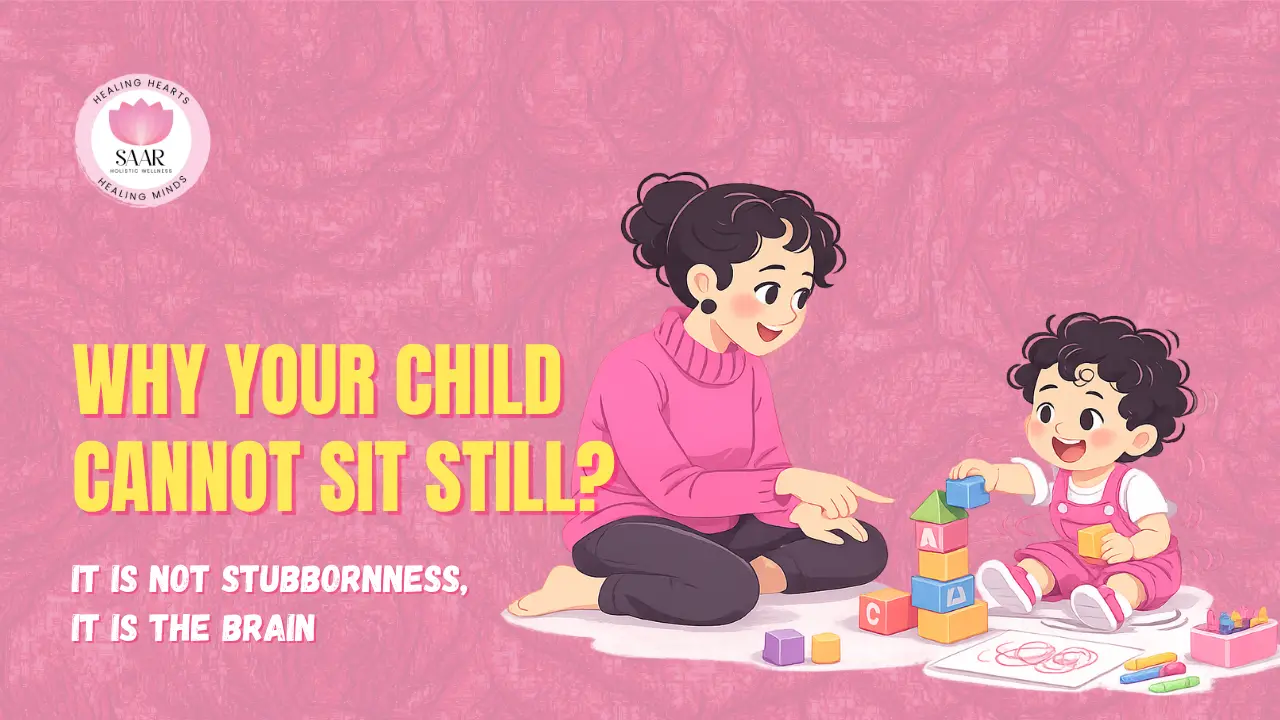
You have said it more times than you can count. “Sit properly.” “Stop moving.” “Just stay in one place.” And every time, it feels like your words are disappearing into thin air. In my years of working with families, this is one of the most exhausting things parents describe to me, not the big crises, but the relentless, daily effort of asking a child to do something that sounds so simple and watching them simply… not do it.
If your child cannot sit still at dinner, during homework, while you are talking to them I want you to hear this first: this is not stubbornness, and it is not bad parenting. For many children, sitting still is not a choice they are refusing to make. It is a skill their brain and body are still learning to manage.
Let us talk about what is actually happening and what genuinely helps.
Why the “Child Cannot Sit Still” Problem Is About the Brain, Not Behaviour
Here is the piece of information that changes everything for most parents I work with.
Sitting still requires more than a decision. It depends on:
- Body control and motor regulation the nervous system must be settled enough to hold a position
- Attention regulation the brain must be engaged enough not to seek stimulation elsewhere
- Impulse management the urge to move must be consciously overridden
- Environmental processing sounds, sights, and sensations around the child must not be overwhelming
For children with hyperactive tendencies, one or more of these systems is still developing. What looks like defiance from the outside is often the body in a high-arousal state, the brain sending a signal that movement is needed, and a child with not enough internal control yet to override that signal.
Calling it misbehaviour is not just inaccurate it is unfair. And it puts the child in an impossible position.
5 Daily Moments When “Sit Still” Becomes a Battle
“Just Stand Still for a Minute But Their Body Won’t Cooperate”
You are buttoning your child’s shirt before school. They keep moving, turning, stepping away. You say, “Just stand still for one minute,” and even that feels impossible.
This is low body regulation, not refusal. Your child’s muscles and nervous system are not yet settled. Standing still requires internal calm and motor control, both of which may not be available at that moment.
What actually helps: Make stillness short and achievable. “Look at me. Stand still for ten seconds. Then you can run to the door.” You are structuring stillness, not demanding it indefinitely.
“You’re Not Even Paying Attention Or Are You?”
You are explaining something and your child is tapping a pencil, looking around, shifting in their seat. You feel frustrated they are clearly not paying attention.
But here is what most people do not know: attention does not always look like stillness. Some children process information better with mild movement. The body movement is actually helping them stay mentally engaged; this is called active attention regulation.
What actually helps: Instead of forcing a “quiet body,” check whether learning is actually happening. “You can hold this while you listen.” “Stay near me and keep your hands busy.” Controlled movement is not distraction, it is a different way of paying attention.
“School Says They Don’t Sit And I See the Same at Home”
When teacher feedback matches what you are experiencing at home, it is easy to feel like something is fundamentally wrong with your child. But your child is not failing school expectations; they are struggling with sustained sitting and structured attention demands. These are specific skills, not character traits.
What actually helps: Build a collaborative approach with the teacher rather than a defensive one. “My child focuses better with short breaks. Could they have a small movement break between tasks?” You are advocating for your child without reducing their dignity or attaching a label.
“Why Are They So Hyper After School?”
Your child comes home and within minutes a bag is thrown, shoes scattered, running, bouncing, talking non-stop. You wonder why they are suddenly worse, when you expected school to have “used up” their energy.
This is not new behaviour. It is a released behaviour. Your child spent hours in school trying to sit, control impulses, follow instructions, and adjust their behaviour to meet expectations. What you see at home is the energy that was held all day, finally finding release.
What actually helps: Do not ask for calm immediately. “Go outside and run for five minutes.” Release first, then guide. “Now let’s sit and eat.” The sequence matters enormously.
“Why Can’t They Behave in Public Places?”
Noise, people, movement, visual input, instructions and public places are genuinely overwhelming for a child with high sensory needs. When the brain becomes overloaded, the body becomes restless. Your child is not misbehaving. They are responding to sensory overload.
What actually helps: Prepare before entering. “Hold my hand. We are going to buy two things. Help me find this.” Give them focus and structure inside the sensory chaos, rather than adding to it with repeated corrections.
The Shift That Changes Everything for Parents
Most parents I work with are asking: “Why won’t my child sit still?” But the more useful question is: “What does my child need in order to be able to sit still?”
That shift from judgment to curiosity changes your response completely. Instead of repeating an instruction that is not working, you start looking at what your child’s body and brain actually need in that moment: movement, regulation, structure, connection, or a sensory outlet.
What Self-Regulation in Children Actually Means
Self-regulation is the ability to manage thoughts, emotions, and behaviour in response to a situation. It does not arrive fully formed. It is built gradually through experience, modelling, and consistent external support which is exactly what you provide when you stop expecting stillness and start preparing your child for it.
Every time you say “Let’s jump ten times, then sit for two minutes” instead of “Why can’t you just sit?”, you are building a neural pathway. Slowly, your child’s capacity to self-regulate grows not because they were corrected, but because they were guided.
This Is the Foundation of What I Share in My Book
Understanding why a child cannot sit still is Chapter 2 of I Am Not Hyper, I Am Helpless and it is one of the chapters parents tell me shifted their daily experience the most. Not because it gave them a trick, but because it gave them a way of seeing their child differently.
When you see the behaviour as a developing skill rather than a character flaw, you stop feeling like you are in a battle. And you start feeling like a partner in your child’s growth.
Want the Full Guide, Including Real-Life Scripts for Every Daily Situation?
I Am Not Hyper, I Am Helpless goes beyond this blog post. It covers every chapter of a hyperactive child’s day mornings, homework, school complaints, emotional outbursts, screen time, and more with real-life parenting scenarios, psychological insight, and practical tools you can use immediately.


