
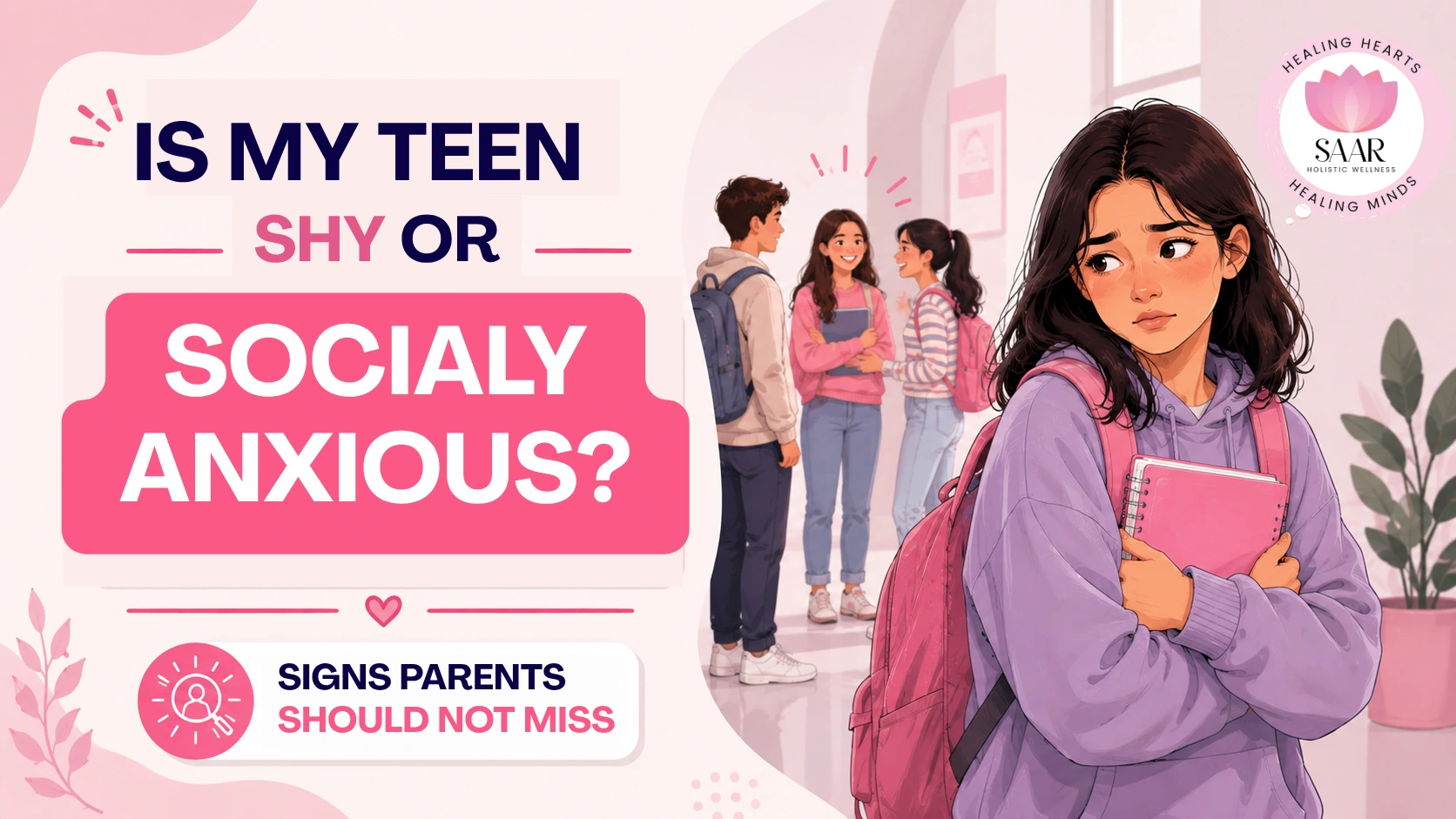
Your teenager may avoid birthday parties, refuse to answer in class, cancel plans with friends, or go completely quiet when relatives visit.
At first, it may seem like shyness.
But inside, your child may be worrying for hours: “What if I say something stupid? What if everyone looks at me? What if they laugh? What if I embarrass myself?”
A community study from northern India found social anxiety symptoms in 14.3% of adolescents who took part. The number is not a label for every quiet teen. But it is a reminder that social anxiety is real, common, and often hidden behind words like “shy,” “reserved,” or “not confident.”
Psychologist Reena Chopra, founder of Saar Holistic Wellness, has supported parents through the confusing gap between normal teenage privacy and emotional withdrawal. Her message is simple: do not rush to label your teen, but do not ignore a pattern that is shrinking their life.
What Is Social Anxiety in Teenagers?
Social anxiety is more than feeling nervous before a presentation or meeting someone new.
A teenager with social anxiety may feel an intense fear of being judged, embarrassed, rejected, watched, or criticised in social situations.
They may want friends, activities, and connection but the fear feels stronger than the wish to join in.
Social anxiety in teenagers can affect:
- Speaking in class
- Giving presentations
- Asking teachers for help
- Joining a new group
- Eating in front of others
- Answering phone calls
- Attending family functions
- Going to parties or school events
- Making eye contact
- Starting conversations
- Posting online or worrying about online reactions
The problem is not a lack of desire. Often, it is the fear that makes participation feel impossible.
Shy vs Socially Anxious Teen: What Is the Difference?
Shyness is a personality trait. A shy teen may need time to warm up in a new setting. They may prefer a small group over a large party. But with time, safety, and familiarity, they can usually participate.
Social anxiety is more intense. It creates distress and begins to interfere with daily life.
A Shy Teen May:
- Prefer familiar people
- Need time to speak in a new group
- Enjoy social events once they settle in
- Feel nervous but still participate when needed
- Have a few close friends and feel comfortable with them
A Socially Anxious Teen May:
- Avoid school events, friends, classes, or activities they actually want to attend
- Feel sick, shaky, sweaty, or breathless before a social situation
- Panic about being judged or humiliated
- Rehearse simple conversations repeatedly
- Stay silent even when they know the answer
- Spend hours replaying a small interaction
- Avoid eye contact, phone calls, or meeting new people
- Feel lonely because fear keeps them away from connection
The key question is not “Is my teen quiet?” It is “Is fear stopping my teen from living normally?”
Teen Social Anxiety Signs Parents May Notice
Teenagers often hide anxiety because they do not want to be questioned, corrected, or treated differently.
Look for patterns such as:
- Refusing to go to school on days with presentations or group activities
- Asking to stay home from parties, outings, or family events
- Avoiding friends they used to enjoy
- Spending a lot of time alone but saying they feel lonely
- Becoming angry when pushed to socialise
- Complaining of stomach aches or headaches before social situations
- Worrying intensely about clothes, appearance, or what others think
- Speaking very softly or not speaking in some settings
- Not asking questions in class even when confused
- Avoiding ordering food, making calls, or talking to adults
- Overthinking messages, likes, comments, or group chats
- Crying or shutting down after a small social embarrassment
One sign alone does not confirm social anxiety. A persistent pattern that affects school, friendships, confidence, or family life is what needs attention.
Why Does Social Anxiety Happen in Teenagers?
There is rarely one single reason.
For some teenagers, social anxiety develops slowly. For others, it becomes stronger after bullying, a friendship breakup, an embarrassing moment, a school change, family stress, or online harassment.
Possible contributing factors include:
- A naturally sensitive or cautious temperament
- Fear of making mistakes
- Perfectionism
- Bullying or exclusion
- Academic pressure
- Body-image worries
- Social media comparison
- Family conflict or major life changes
- Past difficult social experiences
- Other concerns such as depression, general anxiety, ADHD, or neurodivergence
Social media can make this harder, but it is not always the only cause. A teen may compare their real life to carefully edited photos, parties, achievements, and friendships online. Yet simply taking away the phone does not solve the fear underneath.
The goal is not to control every platform. It is to help your teen feel safer in their own skin.
How Parents Can Help Teen Social Anxiety
Start With Curiosity, Not Pressure
If your teen avoids a party, do not begin with:
“Why are you being so difficult?”
Try:
“I noticed you have been avoiding plans lately. I am not here to force you. I want to understand whether something feels uncomfortable.”
This keeps the door open.
Do Not Label Your Teen in Front of Others
Avoid saying, “She is just shy,” “He has no confidence,” or “She never talks.”
These labels can become part of how a teenager sees themselves.
Instead, describe what you notice privately and gently:
“You seemed worried before the school event. Was something making it feel hard?”
Validate the Feeling Without Letting Fear Make Every Decision
You can say:
“I understand this feels scary. You do not have to become the loudest person in the room. Let’s think of one small step that feels possible.”
For example, the first step may be attending a party for thirty minutes, greeting one friend, asking one question in class, or sitting near the entrance instead of staying at home.
Small, repeated steps build confidence better than one big forced exposure.
Help Them Find Their People
Not every teen enjoys a large group. Some feel more comfortable in structured, interest-based spaces.
Support activities connected to what your child genuinely enjoys, such as art, music, sports, coding, reading, volunteering, dance, debate, or a small hobby group.
The aim is not popularity. It is meaningful connection.
Make Home a No-Shame Place
A teen who is terrified of being judged outside should not feel judged at home too.
When they talk, resist the urge to immediately advise, correct, compare, or tell them what you would have done.
Sometimes the most useful reply is:
“That sounds really uncomfortable. Thank you for telling me.”
What Parents Should Avoid
Well-meaning parents can accidentally make social anxiety worse.
Try to avoid:
- Forcing your teen into a large social situation without preparation
- Making jokes about their quietness
- Speaking for them in every situation
- Comparing them to a confident sibling or cousin
- Telling them to “just stop overthinking”
- Treating every cancelled plan as disobedience
- Immediately taking away the phone without understanding the problem
- Assuming social anxiety is only teenage drama
At the same time, do not allow fear to completely take over their life. Gentle support, clear routines, and gradual participation work better than either pressure or complete avoidance.
When Teen Social Anxiety Needs Professional Support
It is time to seek help when anxiety is affecting your teen’s ability to study, make friends, attend school, enjoy activities, or feel safe in daily life.
Consider professional guidance if your teen:
- Avoids school, presentations, or social situations regularly
- Has panic symptoms
- Is being bullied or harassed online
- Is isolated for long periods
- Shows persistent low mood or hopelessness
- Talks negatively about themselves
- Has changes in sleep, eating, or daily routine
- Talks about self-harm or not wanting to be alive
If your child talks about self-harm, suicide, or immediate danger, seek urgent local emergency or mental-health support right away.
A qualified professional can help explore whether social anxiety, depression, ADHD, autism, trauma, learning differences, bullying, or another concern is present. The goal is not to “fix” a teen’s personality. It is to reduce suffering and help them participate in life with more confidence.
Research Sources for Publishing
- A community-based study in northern India found anxiety disorders in 22.7% of participating adolescents; social anxiety was the most common subtype, reported in 14.3%. Read More…
- A 2025 Delhi study also reported social anxiety as the most common anxiety disorder among surveyed urban adolescents. Read More…
- Research on rural Indian adolescents has reported substantial variation in social-anxiety estimates across studies, underlining the importance of culturally sensitive support and assessment. Read More…
Your teenager does not need to become loud, outgoing, or exactly like anyone else. They deserve to feel safe enough to be themselves.


