
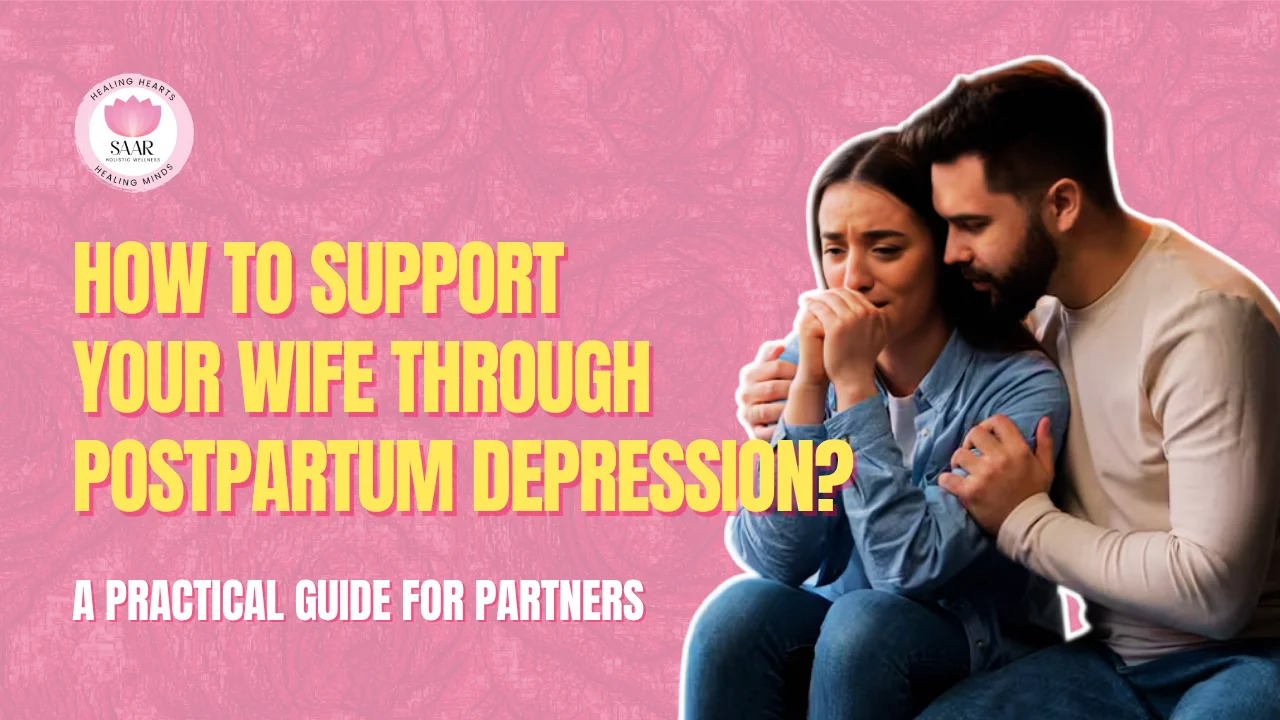
In my practice, I often meet fathers and partners who come to me not for themselves, but because they are quietly falling apart watching someone they love disappear into something they cannot name. Their wives who were excited, capable, and strong suddenly seem unreachable. And these partners sit across from me and ask the same question, almost word for word: “What am I doing wrong? Why can’t I fix this?”
Here is what I tell them first: You are not doing anything wrong. And this is not yours to fix alone.
According to the World Health Organization, postpartum depression affects approximately 1 in 5 women globally in the year following childbirth. In India, studies suggest the prevalence may be even higher with many cases going unrecognised and unsupported because of stigma, silence, and a cultural script that says new mothers should be glowing, grateful, and fine.
They are often not fine. And the people closest to them, partners, in-laws, family are often the most confused about why.
This post is for you. The husband who doesn’t know what to say. The partner who is trying everything and feels like nothing is working. I want to give you something real to hold onto.
What Postpartum Depression Actually Looks Like (It’s Not Always Tears)
One of the biggest reasons PPD goes unrecognised at home is that it doesn’t always look like sadness. In my experience, what families often see is something harder to name.
Your wife may seem irritable, withdrawn, or emotionally flat. She might be going through the motions of caring for the baby but feeling nothing. She may snap at you and then feel crushing guilt about it. She might say she is fine when she is clearly not, because somewhere she has absorbed the message that a good mother doesn’t struggle.
Postpartum depression (PPD) is a mood disorder not a character flaw, not a failure of love, not a sign that she doesn’t want the baby. It is a clinical condition that can emerge anytime in the first year after birth, caused by a complex mix of hormonal shifts, sleep deprivation, identity change, and unmet emotional needs.
The signs to gently watch for include: persistent sadness or emptiness, loss of interest in things she used to enjoy, difficulty bonding with the baby, extreme exhaustion beyond ordinary new-parent tiredness, anxiety or intrusive thoughts, and withdrawing from the people around her.
If something feels off, trust that instinct. You know her.
Why “Just Be Positive” Doesn’t Work And What She Actually Needs to Hear
I cannot count the number of times a well-meaning partner has told their wife: “But you have so much to be grateful for. The baby is healthy. We are fine. It will get better.”
All of that may be true. And none of it helps.
When someone is in the grip of postpartum depression, being told to look on the bright side can feel like being handed an umbrella and told to think of it as sunshine. It doesn’t address what’s actually happening inside her and worse, it can make her feel more alone, more misunderstood, more ashamed for not being able to feel what she’s “supposed to” feel.
What she actually needs to hear is simpler than you think:
“I see you. I’m not going anywhere. You don’t have to pretend with me.”
That’s it. You don’t need the perfect words. You need to stop reaching for the silver lining and just sit with her in the hard part. Validation not a solution is what breaks the isolation of PPD.
Ask her how she is feeling without immediately trying to solve it. Listen without interrupting. Let there be silence if she needs it. Presence, consistent and non-judgmental, is its own kind of medicine.
Practical Ways Partners Can Show Up Every Single Day
Emotional support matters enormously. So does the practical. In my practice, I’ve seen how the mental load of a new baby feeding schedules, doctor visits, household decisions, extended family management falls disproportionately on the mother, even when she is struggling.
Here is what showing up concretely looks like:
- Take over without being asked. Don’t wait for her to delegate. If the baby needs a bath, give it. If the dishes are piling up, do them. If she hasn’t eaten, make her something. Remove the labour of her having to ask and explain and manage you.
- Protect her sleep. Sleep deprivation is both a symptom and an amplifier of PPD. Take a night feed. Let her sleep in when you can. Coordinating with family to give her uninterrupted rest even two to three hours can shift how a person feels.
- Shield her from unsolicited opinions. Well-meaning relatives who comment on the baby’s weight, her feeding choices, her appearance, her emotions that noise can be devastating when someone is already fragile. You are allowed to set a quiet boundary. You don’t have to announce it. Just redirect the conversation.
- Create small moments of normalcy. A cup of chai (Tea) made the way she likes it. Sitting together without talking about the baby. A short walk. Small anchors to who she is outside of motherhood.
None of this is dramatic. All of it is meaningful.
The Role of Family – How In-Laws and Loved Ones Can Help Without Adding Pressure
In many Indian households, the arrival of a baby brings the entire family in physically, emotionally, and with opinions. This can be a genuine gift. A new mother surrounded by a loving, involved family has real support. But it can also add a layer of invisible pressure that nobody intends.
Comments about how she looks. Comparisons to how things were done “in our time.” Taking over the baby in ways that make her feel sidelined. Assuming she should be happy because she has so much help.
If you are an in-law or extended family member reading this your presence matters deeply. What the new mother in your home needs from you is not perfection. She needs warmth without judgment. Help without commentary. Love that doesn’t come with conditions attached to how she is coping.
Practically: cook a meal without making it about feeding the baby. Sit with her quietly. Ask what she needs, and listen to the answer even if it surprises you. Do not minimise what she is going through by comparing it to your own experience of new motherhood.
And if you notice she seems to be struggling to say something kind and private. Not to the group. Not with alarm. Just: “I’m here. Tell me what’s hard.”
When to Gently Encourage Professional Support And How to Do It Without Making Her Feel Broken
There will come a point when love and presence are not enough on their own and that is not a failure of love. It is simply the reality of what PPD is: a condition that often requires professional care to treat properly.
If you are seeing her symptoms persist or worsen over several weeks, if she is expressing hopelessness, if she is struggling to care for herself or the baby, or if she says anything that worries you about her safety please act. Don’t wait for it to pass on its own.
How you bring up professional support matters enormously.
Not: “I think you need to see someone.” (This can feel like a verdict.)
Instead: “I’ve been reading a bit about what you might be going through, and I found someone who sounds really good: a child psychologist and parenting expert who works with families through exactly this. Would you be open to just having one conversation? I’ll come with you if you want.”
Come from a place of we, not you. Frame it as something you are doing together, not something wrong with her that needs fixing.
At Saar Holistic Wellness, I work with families, not just mothers, through exactly this kind of transition. PPD is not the end of the story. With the right support, it can become something you both move through and understand, together.
A Note to the Mothers Reading This
If you found this post and sent it to your partner I see you. That took courage.
If you are reading it alone, quietly, recognising yourself in these words that takes courage too.
What you are going through is real. It does not mean you love your baby less. It does not mean you are weak or broken or failing. It means you are human, and you need support and wanting that support is one of the bravest things a new mother can do.
You do not have to wait until things get worse to reach out. You can ask for help right now, exactly as you are.
You Don’t Have to Get This Perfect
To the partners reading this: You will not always say the right thing. You will sometimes get it wrong. That is okay. What matters is that you keep showing up consistently, patiently, without keeping score.Postpartum depression is hard. But isolation makes it harder. Your imperfect, steady, loving presence is one of the most powerful things your wife has right now.


