
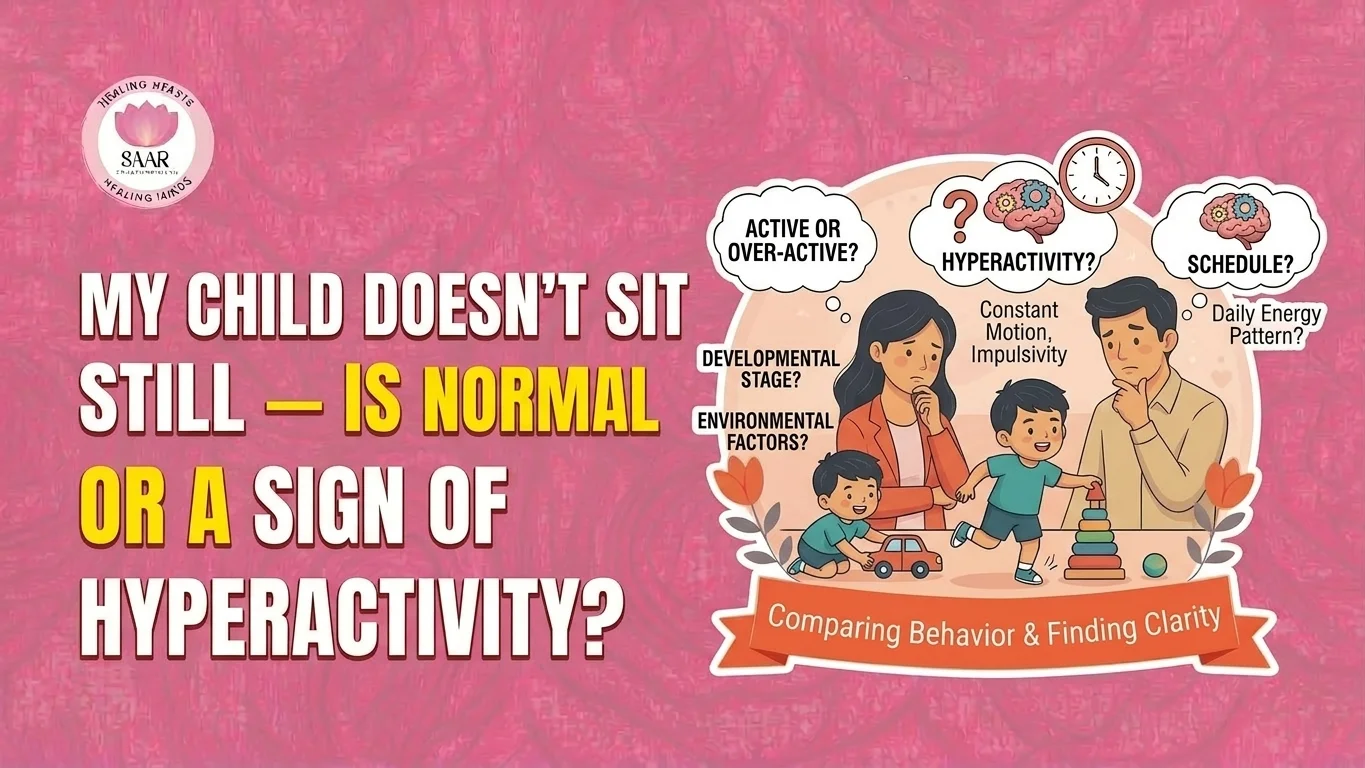
When “Sit Still” Becomes a Daily Struggle
If you find yourself saying “Sit properly!”, “Stay in one place!” or “Why can’t you just sit quietly?” multiple times a day, you’re not alone.
Many parents, especially mothers, feel exhausted managing a child who:
- Keeps moving constantly
- Struggles to sit during meals or studies
- Gets frequent complaints from school
- Seems “always on the go”
And slowly, a question starts building:
👉 Is this normal… or is something wrong?
Is It Normal for Children to Not Sit Still?
Yes, to an extent.
Children are naturally active. Movement is how they explore, learn, and express themselves.
An active child:
- Can sit for short periods when needed
- Calms down with reminders
- Adjusts behavior in structured environments
- Shows control in familiar situations
So occasional restlessness is completely normal.
When It Might Be More Than Just “Active”
If you’re wondering whether your child is hyperactive, look at consistency and control.
It may be a sign of hyperactivity if your child:
- Rarely sits still, even for a few minutes
- Struggles in school settings regularly
- Acts impulsively without thinking
- Interrupts or talks excessively
- Finds it hard to follow instructions
- Gets frequent feedback from teachers
The key difference is this:
👉 Active children choose movement
👉 Hyperactive children often can’t control it
Why This Happens (And Why It’s Not Your Fault)
Many parents blame themselves.
But hyperactivity is often linked to:
- Brain development and impulse control
- Emotional regulation challenges
- Sensory processing differences
- High energy with low regulation skills
This is not about “bad parenting” or “not being strict enough.”
💛 A Special Note for Mothers
Let’s talk honestly.
When a child doesn’t sit still, society often points at the mother first.
You may hear:
- “You need to discipline him better”
- “You’re too soft”
- “Other kids don’t behave like this”
And inside, you feel:
- Guilty
- Embarrassed
- Frustrated
- Tired of being judged
But here’s what no one says out loud:
👉 You are not raising your child wrong
👉 You are raising a child who may need different support
And that is not failure that is awareness.
What You Can Do as a Parent
1️⃣ Focus on Structure, Not Control
Create routines. Predictability helps children regulate better.
2️⃣ Give Short, Clear Instructions
Avoid long lectures. Keep communication simple and calm.
3️⃣ Allow Safe Movement
Instead of stopping energy, channel it through physical activity.
4️⃣ Avoid Constant Scolding
Too much correction reduces confidence and increases resistance.
5️⃣ Observe Before Reacting
Notice when behavior is strongest patterns help you understand triggers.
When Should You Seek Support?
If your child:
- Struggles daily at school
- Faces repeated complaints
- Feels frustrated or misunderstood
- Makes parenting feel overwhelming
Getting guidance can make a huge difference.
If you’re a mother feeling:
- Constantly blamed
- Emotionally drained
- Confused about your child’s behavior
- Tired of trying everything without results
You don’t have to figure this out alone.
Our one-to-one parenting counselling sessions help you:
- Understand your child’s behavior clearly
- Learn calm, practical strategies
- Handle school complaints confidently
- Reduce guilt and emotional stress
👉 Book a session today and start parenting with clarity, not confusion.
A Gentle Reminder
Your child is not “too much.”
Your child is learning how to regulate.
And you…
You are doing better than you think.


