
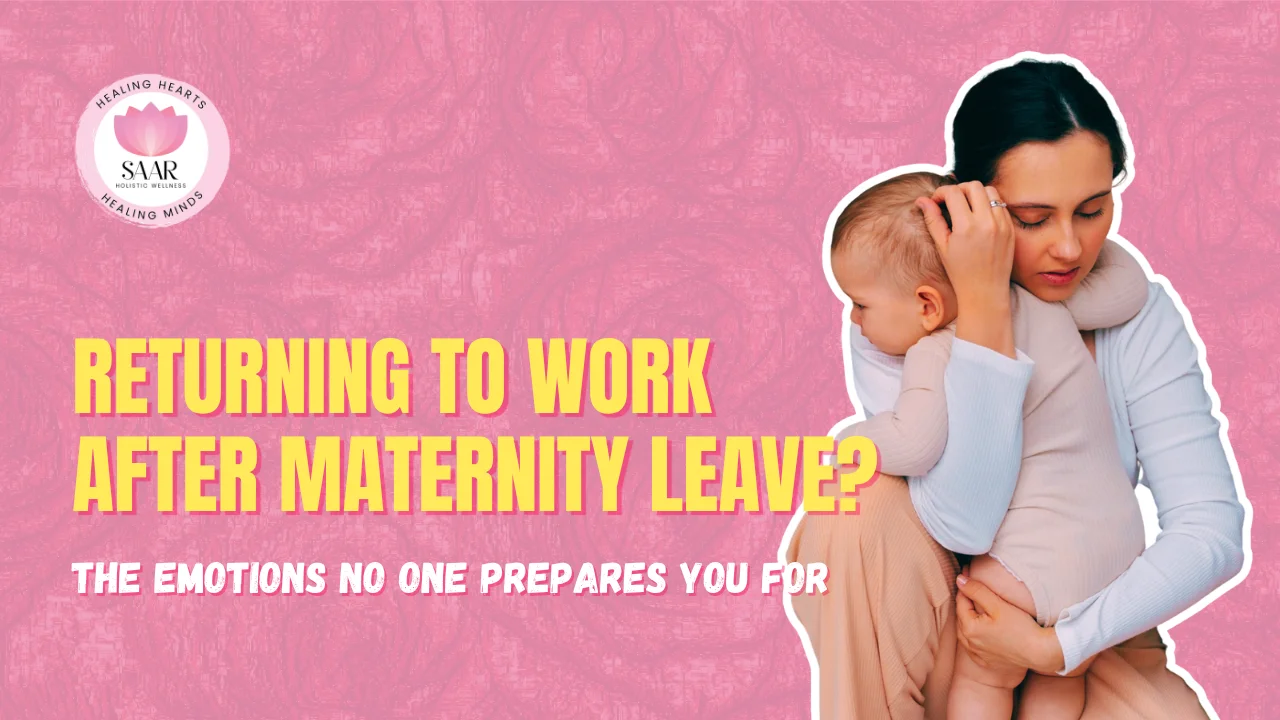
A Statistic That Stopped Me Mid-Session
According to a 2023 survey by the American Psychological Association, 68% of new mothers report significant anxiety when returning to the workplace after childbirth. In my 17 years as a child psychologist and parenting coach, I can tell you that number sounds about right and yet, not a single one of the mothers I work with was told to expect it.
We talk about sleep deprivation. We talk about feeding schedules. We talk about developmental milestones. But we almost never talk honestly about the storm of emotions that hits when a mother has to pack her bag, drop her baby off with someone else, and walk back into a professional life that was paused as her maternity leave.
If you’re preparing to go back to work after maternity leave or if you’re already back and feeling things you didn’t expect I want you to know something first: what you’re feeling is not weakness. It is not a sign that you made the wrong choice. It is a normal, deeply human response to one of the biggest transitions a woman will ever face.
Why Returning to Work After Maternity Leave Feels So Hard
I often see mothers come into my practice weeks before their return date already dreading it. There’s an assumption that the hard part of early motherhood is the sleepless nights and the newborn phase and that going back to work means things are returning to ‘normal.’ But here’s what I want to gently challenge: you are not returning to normal. You are a different person than the one who went on leave and workplaces, for the most part, don’t account for that.
Research published in the Archives of Women’s Mental Health (2024) found that the return to work is one of the most psychologically stressful transitions mothers experience distinct from general postpartum anxiety and, for many women, the moment at which that anxiety peaks. The stress often shows up as what researchers call ‘postpartum work resumption stress’ a layered combination of separation anxiety, identity confusion, and exhaustion.
| The transition back to work represents one of the most significant psychological adjustments in a new mother’s journey. Acknowledging these emotions is the first step to developing healthier coping patterns. |
The Emotions Nobody Warned You About
The Guilt That Follows You Everywhere
Mom guilt going back to work is perhaps the emotion mothers talk about most and yet still feel most alone. You feel guilty at work for not being with your baby. You feel guilty at home for not being fully present because your mind is still in your inbox. It’s a tug-of-war with no clean resolution, and society has a way of quietly suggesting that ‘good mothers’ don’t leave.
What I tell my clients is this: guilt is not evidence of wrongdoing. Guilt, in this context, is evidence of how much you love your child. Reframing it doesn’t make it go away immediately but it does shift your relationship with it.
Grief Yes, Grief
Nobody prepares you for the grief that can come with returning to work after maternity leave. Grief for the slow mornings you won’t have anymore. Grief for the version of yourself that existed for those months of leave. Grief, sometimes, for the career identity you thought you’d slip back into easily only to find it doesn’t quite fit the new you.
This is normal. It is not depression (though postpartum depression is also real and worth taking seriously). It is the natural grief of transition.
Anxiety That Sits in Your Chest
Maternity leave anxiety when going back to work often looks like: lying awake at 3 AM running through logistics. Refreshing the childcare provider’s messages. Catastrophising about everything that could go wrong. For many mothers, this is their first time away from their baby for long stretches and their nervous system hasn’t caught up with the plan their rational mind has made.
A 2025 longitudinal study that tracked 271 mothers over six months found that stress levels were highest at the very start of the return-to-work transition, then declined steadily over time. This matters. It means the hardest moment is usually the beginning, not forever.
The Identity Shift Nobody Names
Before you became a mother, you may have known yourself very clearly through your work, your role, your skills, your sense of contribution. Motherhood rewrites that. Returning to work after maternity leave often triggers what I call a ‘dual identity crisis’: you feel like you’re not fully professional anymore, and not fully ‘just a mother’ either. You are suspended between two worlds.
This is not a flaw in you. It is a feature of the profound transformation that motherhood brings something I explore in depth when I work with mothers navigating this period.
What the Research Says About Your Mental Health During This Time
It’s important to acknowledge that for some mothers, the return to work coincides with an undiagnosed postpartum mental health challenge. Research shows that mothers who experienced depression or anxiety during pregnancy are at significantly higher risk of struggling when they go back to work. The three-to-four month mark when many mothers in shorter-leave countries return is also a vulnerable window for postpartum depression to surface or intensify.
If you are crying every day, feeling disconnected from your baby, unable to concentrate, or experiencing persistent dread about returning to work, please don’t white-knuckle through it alone. These are signals worth paying attention to.
What Actually Helps From My Practice
In my practice at Saar Holistic Wellness, I work with mothers through this exact transition. Here is what I have seen help, again and again:
Name what you’re feeling, specifically. ‘I’m sad’ is vague. ‘I’m grieving the mornings I’ll lose’ gives your emotion somewhere to land and something specific to work with.
Plan micro-rituals for connection. A song you sing with your baby before you leave. A photo on your desk. A dedicated fifteen minutes in the evening when your phone goes down and you are simply present. Connection is not about quantity of time. It’s about quality of attention.
Talk to someone who won’t minimise it. Not someone who says ‘you’ll be fine.’ Someone who can sit with you in complexity. A therapist, or even a trusted community of mothers who understand.
Lower your expectations for the first month. You are re-learning how to hold two worlds simultaneously. Give yourself the grace you would give a friend.
A Gentle Note Before You Go
Returning to work after maternity leave is hard. The emotions are real. The grief is valid. The anxiety makes sense. And none of it means you are doing motherhood wrong.


