
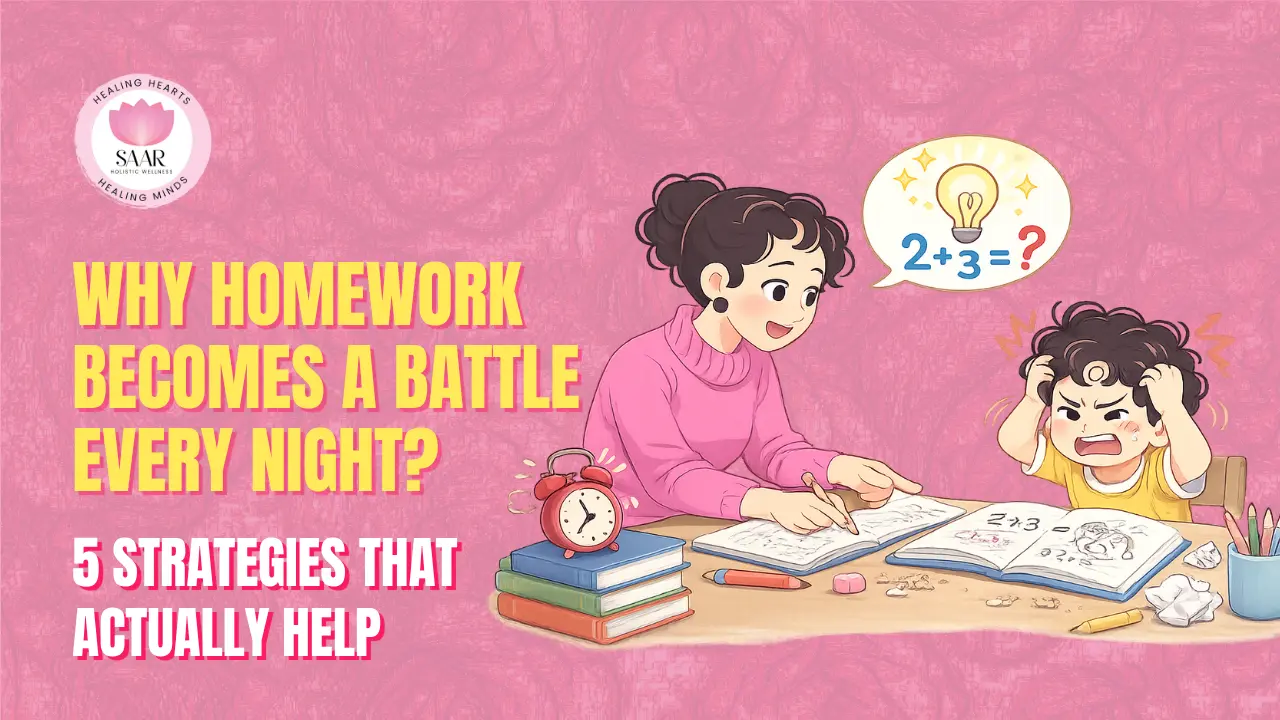
Research published in the International Journal of Educational Research found that parents of children with ADHD describe homework as a persistently stressful part of their family’s daily life and called for targeted parenting interventions to address it. (Source: ScienceDirect, 2023)
I did not need a study to tell me this. I hear it every week.
Mothers who sit down with me and describe the same ritual, night after night. You set up the table with hope “Today will be different.” Within minutes, your child is looking away, touching things, getting up for water, starting anything except homework. By the time the page is half done, voices have risen, tears may have fallen, and the evening you both needed to recover from the day has become the hardest part of it.
Homework battles with children are one of the most common challenges families bring to me. And what I want to tell you before we talk about strategies is that this is not about laziness, and it is not about your child choosing not to try. It is about a brain that is genuinely working hard, in a way that does not always show up on the page.
Let me explain what is actually happening.
Why Homework Is Harder Than It Looks – The Brain Behind the Battle
Homework is not just writing. It depends on a set of cognitive skills that many children especially those with hyperactive tendencies or attention difficulties find genuinely taxing:
Attention span: How long the brain can stay engaged with a single task before fatigue sets in.
Working memory: The ability to hold an instruction in mind long enough to act on it. Children with ADHD often argue about what teachers assigned, when work is due, and how much time to devote because working memory difficulties make it hard to retain and retrieve this information accurately.
Executive function: Starting, planning, sequencing, and finishing tasks. Children with ADHD struggle with task initiation getting started feels overwhelming, even when they know what needs to be done.
Cognitive load: How much the brain is handling at once. After a full school day of sitting, listening, managing impulses, and following instructions, many children arrive home with their cognitive resources already depleted.
When these systems are overloaded, your child does not say “I am cognitively exhausted.” They show it as distraction, delay, and resistance. And what looks like refusal is often the brain’s honest signal that it has run out of capacity.
5 Practical Strategies to Reduce Homework Battles at Home
These are not generic tips. They come directly from what I see working with families in my practice and from Chapter 6 of I Am Not Hyper, I Am Helpless, which goes deeper into each one.
Strategy 1 Sit Closer, Not Louder
When distraction begins early, the instinct is to repeat the instruction more firmly. In my practice, I find the opposite works better.
Instead of standing across the room saying “Focus, we just started,” sit beside your child. Your physical presence acts as an external regulation tool that reduces the cognitive demand of sustaining attention alone.
Point to the task with your finger: “Let’s just do this much together.” You are not doing the work for them. You are lending them your nervous system as a steadying anchor, while their own attention system catches up.
Being nearby to answer questions and redirect focus without hovering creates a reassuring presence, not a stressful one. The distinction is in your energy, not just your proximity.
Strategy 2 Make the Instruction Stick, Not Just Louder
One of the most common homework patterns I see: a parent explains the task, the child nods, and then does nothing. The parent repeats twice, three times, four times and by the fifth repetition, the tone has changed.
This is almost always a working memory issue, not a listening issue. Your child heard the instructions simply did not stay long enough to be acted on.
Instead of repeating the same words, try this: go close, point to the question, and ask your child to tell you what they need to do. “Tell me what this question is asking.” Let them say it back. Then: “Good. Now start. I am right here.”
That loop hearing, repeating, starting activates the working memory pathway in a way that your repeated instructions cannot. You shift from shouting the instruction to anchoring it.
Strategy 3 Cover the Page
A full page of homework can feel genuinely overwhelming to a child with attention or executive function difficulties. It is not a drama. It is what the brain experiences when it sees a large task and cannot naturally break it into steps.
The fix is beautifully simple: cover part of the page.
Show only the first two questions. “We are just doing this section.” When done: “See, this part is complete.” That moment of completion matters more than you might think. Children with ADHD often struggle with task initiation, and the experience of completion creates a small dopamine response that makes the next section easier to start.
You are reducing cognitive load and using the brain’s own motivation chemistry. Not bribing. Engineering the environment to work with how your child’s brain actually functions.
Strategy 4 Stay Neutral When Mistakes Appear
One of the most painful homework moments for parents: you practiced the material yesterday. Today, mistakes are everywhere. You feel confused and frustrated “How can you not know this? We went over it together.”
This is not knowledge loss. ADHD-related homework challenges affect not just completing assignments, but the consistency of performance children with ADHD often experience increased stress and anxiety around homework, which further impairs their ability to retrieve and apply what they know.
When the brain is tired or anxious, steps are skipped, focus drops, and errors increase even when the child genuinely knows the work.
The response that helps most here is deceptively simple: lower your tone, sit beside them, and say “Let’s check this one together.” Not “How many times have I taught you this?” Neutral presence reduces performance anxiety. And reduced anxiety improves output because the brain can now access what it already holds.
Strategy 5 Address the Emotion Before the Argument
When homework consistently turns into an argument, the surface issue is compliance. The deeper issue is almost always emotional resistance and it usually sounds like this inside your child’s head:
“This is too hard.” “I might get it wrong.” “I don’t want to try and fail.”
So they avoid it. And when you push, their brain moves into defence mode which makes the argument feel inevitable. A student’s avoidance is often a coping mechanism to avoid the stress of homework. When parents start increasing pressure through nagging and hovering, it can make homework more stressful and the avoidance stronger.
What breaks this cycle is not firmness. It is connected before correction.
Sit beside them, not opposite. Lower your voice: “I know this feels hard. Let’s just start together.” Pick up the pencil with them if needed. You are not lowering your expectations. You are lowering their fear and that is what actually creates cooperation.
The Shift That Changes Homework Time
Most homework battles are fought on the wrong battlefield. Parents are fighting for compliance. Children are fighting without knowing it for safety: “I need to know I won’t fail. I need to know you are not disappointed in me. I need to know I can do this.”
When you move from “Why can’t you just do it?” to “What is making this hard for you?” something shifts. Not just in the homework. In the relationship. In the trust that your child brings to the table every evening.
That shift is not about being softer on expectations. It is about being smarter in how you deliver them.
What Homework Is Really Teaching Beyond the Page
I end Chapter 6 of I Am Not Hyper, I Am Helpless with a reflection I want to share here too.
Homework is not just about learning the curriculum. It is where your child meets effort, frustration, and self-doubt often all in the same sitting. And it is where you meet patience, exhaustion, and expectation often all in the same evening.
What your child needs from you in that space is not a taskmaster. It is a co-regulator, someone who can stay calm when they cannot, stay present when they want to give up, and stay warm when the situation is anything but.
That is not a small thing to ask of a parent. I know that.
Want a Calmer Homework Experience Starting This Week?
I Am Not Hyper, I Am Helpless gives you the full psychological picture behind homework battles with children and walks you through every real-life scenario from “We just started, why are you already distracted?” to “You knew this yesterday, what happened today?”


