
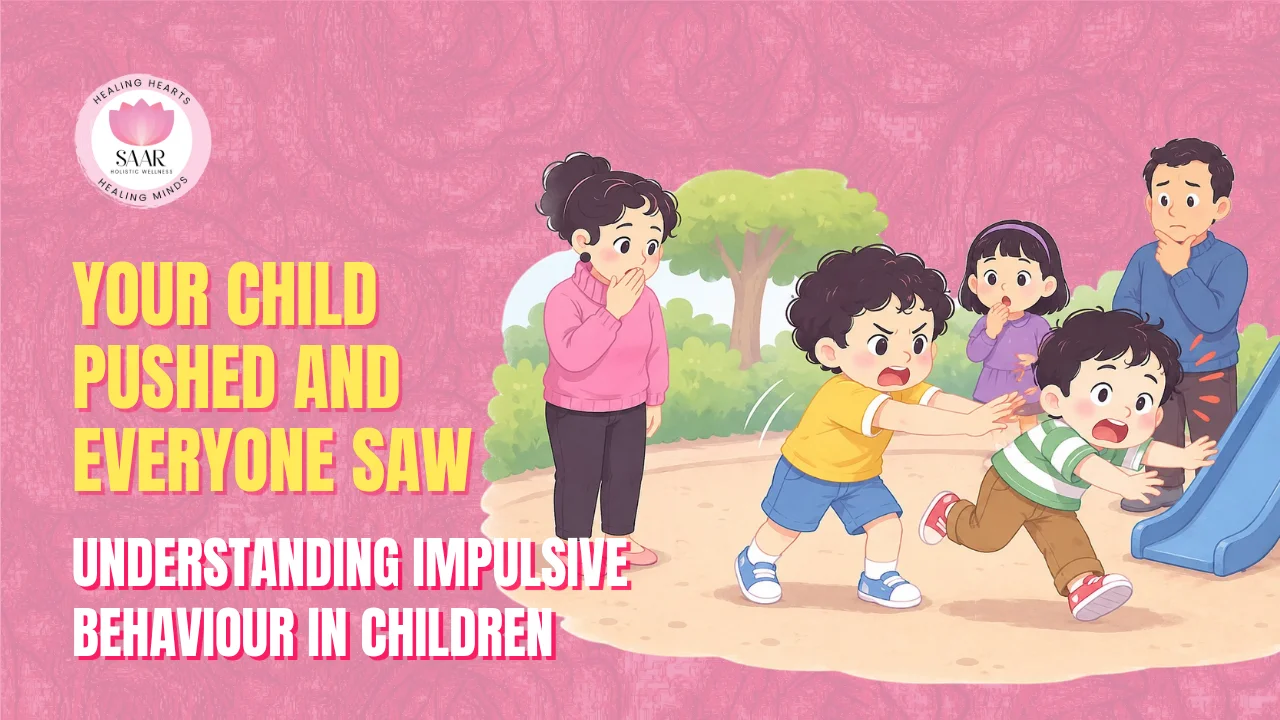
A 2021 study of 710 children aged 7–12 found that major improvements in impulse control occur only around grades 4 and 5 reflecting significant neurological changes that take years to develop. (Source: Handspring Health, citing peer-reviewed developmental research, 2025)
I think about that statistic often when I sit with mothers who come to me after a difficult incident at a birthday party, a playdate, or a family gathering. A push. A sudden grab. A shout in the middle of someone else’s sentence. And in the seconds that followed the stares, the silence, the burning feeling of being judged, something inside that mother quietly breaks.
I have been in that room with hundreds of parents. And what I want you to know, before anything else, is this: your child was not trying to embarrass you. They were trying to manage a feeling that moved faster than their control could catch.
That is what impulsive behaviour in children actually is. Not defiance. Not a bad character. A timing gap between the feeling and the ability to pause.
What Impulsive Behaviour in Children Really Means And What It Does Not
Impulsive behaviour is action that happens before thought. It is not planned, not chosen, and not a reflection of how you have raised your child. Impulsivity is a behaviour pattern that starts in the brain. A certain amount of impulsive behaviour is common, especially in children, and is not necessarily a sign of trouble; it is typical for children to act impulsively because their brains are still developing.
The part of the brain that controls impulses in the prefrontal cortex is the last region to fully mature. The brain is fully mature by 25 years old for neurotypical children, and around 28 years old for children with ADHD. When you ask a seven-year-old to pause, think, and choose a different response in a heated moment, you are asking something of a brain system that is genuinely not yet built for it.
Children with developing impulse control may:
- React before thinking through the consequences
- Struggle to wait their turn in a game or conversation
- Interrupt without realising they have done so
- Act on immediate feelings grabbing, pushing, shouting before memory of “what we talked about” arrives
This is not about intention. It is about the timing between feeling and action and that timing is still being built.
The Moment That Hurts Most When Everyone Is Watching
Before we talk about what to do, I want to sit for a moment with what it actually feels like.
Your child pushes another child. Or grab a toy. Or shouts across a room full of people. And before you have even processed what happened, you feel two things at once: shock and embarrassment. You step in immediately. You correct, you apologise on their behalf, you try to manage the situation.
And then someone gives you that look.
Maybe another parent pulls their child away slightly. Maybe there is a comment, politely worded, that still stings. Maybe no one says anything and that silence is somehow worse.
The Social Judgment That No One Talks About Openly
Parents of impulsive children carry a weight that is rarely acknowledged: the social cost of your child’s behaviour falling on you. Every playdate that ends early. Every gathering where you spend more energy managing behaviour than connecting with other adults. Every time you see another parent watching and wondering.
I want to name this directly: the social judgment is real, and it is exhausting. But it is also deeply unfair because it is based on a misreading of what is actually happening. Your child is not poorly parented. They are neurologically still in the early stages of a skill that takes years to develop.
What helps here is not defending your child loudly in the moment. It is building your own clarity privately so that when the looks come, you have something solid to return to. My child is still learning. This is a developing skill, not a character flaw.
That clarity protects your child’s dignity. And it protects yours.
5 Daily Moments of Impulsive Behaviour And What to Do Instead
“Why Did You Push Like That?” The Toy Was Taken
Two children are playing. A toy is taken. Within seconds, your child pushes. No warning. No words. Just action.
What happened here is not aggression. It is the feeling arriving before the words could. Your child experienced some frustration, loss, unfairness and their brain reacted before their impulse control system could intervene.
Correcting the behaviour matters. But correct it by teaching the missing step, not just stopping the action.
Instead of: “Why did you do that?”
Try: “You felt upset when the toy was taken. Next time, use your words to say: that was mine.”
You are not excusing the push. You are building the bridge between feeling and response that your child’s brain has not yet made automatic.
“Why Can’t You Wait for Your Turn?” The Grabbing and Interrupting
At a gathering, your child grabs first, interrupts, speaks over others. You feel uncomfortable. Other parents notice.
Waiting is not simply patience. It is a combination of impulse control, emotional regulation, and time awareness. Your child is not refusing to wait. They are struggling to hold their needs long enough for the right moment to arrive.
Instead of expecting long waiting, build short and manageable pauses: “Wait five seconds. Now your turn.” Gradually extend the waiting time over days and weeks. You are building the skill incrementally, not demanding it all at once.
“Why Do You Keep Interrupting Every Conversation?” The Constant Intrusion
You are speaking to someone. Your child keeps interjecting “Mum… Mum… Mum…” even after you have said wait.
This is almost never about disrespect. It is about urgency in thought, difficulty holding information, and the fear of forgetting what they want to say. Their brain cannot park an idea and retrieve it later so it pushes it out immediately.
Teach a replacement behaviour rather than demanding silence. A simple gesture works well: “Put your hand on my arm when you need me.” You acknowledge it “I know you have something to say. Wait.” and you create a bridge that keeps the connection without breaking yours.
“You Said Sorry But Then Did It Again”
After an incident, your child says sorry. And then the same behaviour happens an hour later.
This is one of the most frustrating experiences for parents and one of the most misunderstood. Children may understand after the moment, but in the next moment, the impulse arrives faster than memory. Saying sorry is an acknowledgement of the past. It is not yet a control mechanism for the future.
After sorry, add the next step: “Next time, what can you do instead?” Help them say it out loud. “I will ask.” “I will wait.” “I will call you.” You are strengthening the awareness before the next situation arrives, not punishing them for the limitation of their current brain development.
“Is This Behaviour Or Is This Something They Cannot Control?”
Many parents reach a point where they start asking this question, quietly. Is my child being careless? Or are they genuinely unable to stop themselves?
Ask it differently: “Does my child know what to do but struggle to do it at the moment?”
If yes, it is not wilful misbehaviour. It is a skill gap. Impulse control develops with age, practice, and consistent guidance not fear, not punishment.
This reframe does not remove accountability. It changes how you deliver it from reaction to guidance, from repeated correction to steady, patient teaching.
What You Can Do Before the Moment Arrives Not Just After
Most impulse-control parenting happens after the incident. A better approach is to build structure and awareness before the moment even begins.
Pre-Guidance Changes Everything
Before entering a situation where impulse control will be tested a party, a gathering, a playdate prepare your child:
“When we get there, we wait for our turn.”
“If you feel upset, come find me before you do anything.”
“If someone takes your toy, use your words first.”
You are not predicting failure. You are activating the part of your child’s brain that holds the instruction so it has a slightly better chance of arriving before the impulse does.
This is what building impulse control actually looks like. Not a punishment system. Not a reward chart alone. Consistent, calm, pre-emptive guidance that slowly over months, not days builds the pause between feeling and action.
A Note to the Parent Who Is Tired of Apologising
If you have spent many months managing the social fallout of your child’s impulsive moments I want to say something directly to you.
You are not failing. You are parenting a child who is still learning a skill that takes years to mature, in a world that expects it to arrive much sooner. The stares are not a verdict. The playdate that went wrong is not the whole story. And your child, who pushed or grabbed or interrupted is not their worst moment.
They are still learning. And so, in many ways, are we.
Want to Understand Your Child’s Brain More Deeply?
Chapter 5 of I Am Not Hyper, I Am Helpless is dedicated entirely to impulsive behaviour, what is behind it, what five common daily scenarios actually look like in real life, and what shifts the pattern over time. It is written from 17 years of working with families who were exhausted, embarrassed, and searching for something more than generic advice.


