
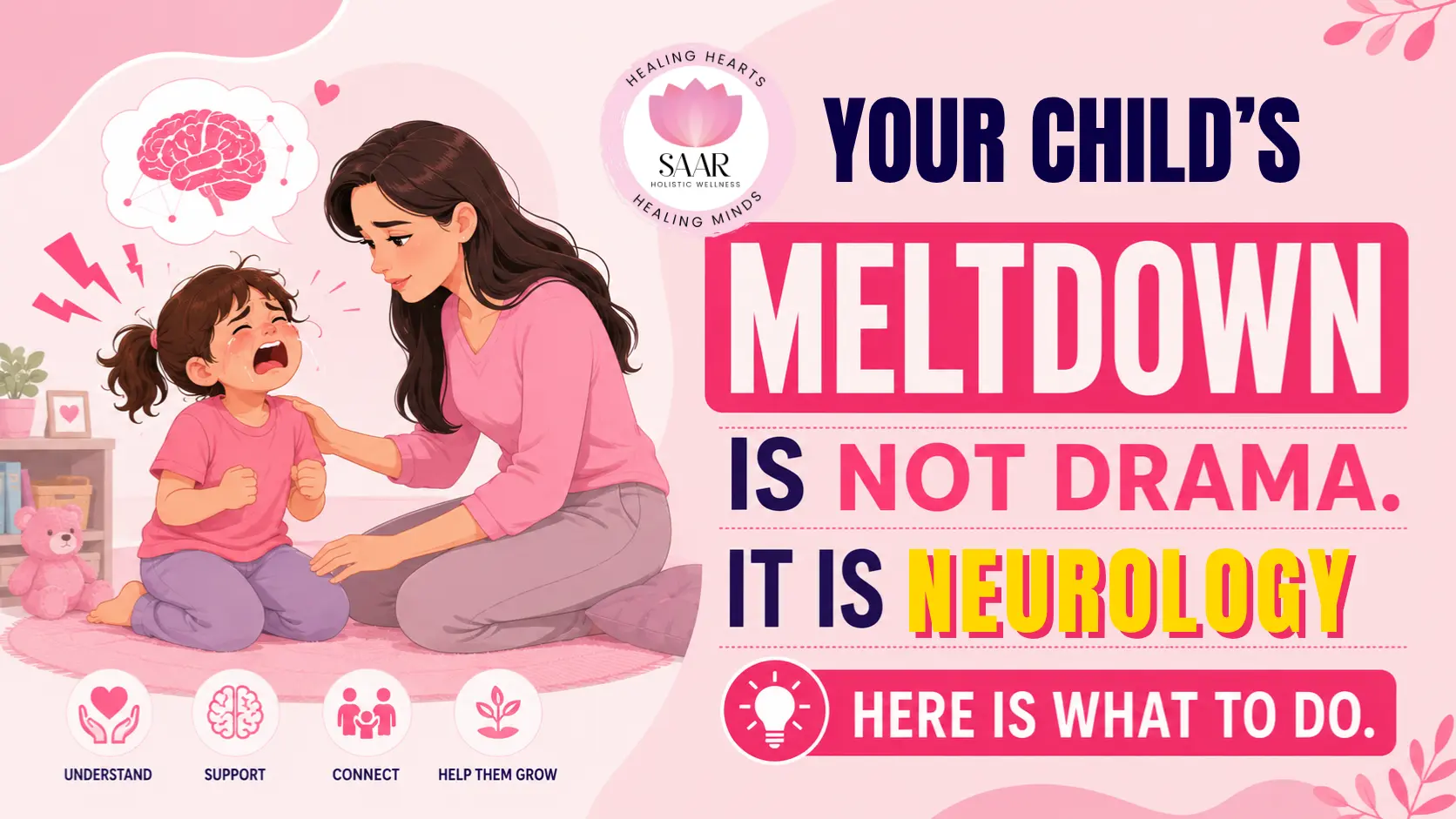
The most common problem bringing young children to the attention of a psychologist is emotional outbursts and meltdowns. Whether mild or severe, tantrums are symptoms that a child is struggling with emotions they cannot regulate. They are among the biggest challenges of parenting. They are hard to understand, hard to prevent, and even harder to respond to effectively when they are happening. (Source: Child Mind Institute, 2026)
I have sat with hundreds of parents after these moments. And the thing I hear most, underneath the frustration, is a quieter question: “Is something wrong with my child? Why does something so small cause something this big?”
Nothing is wrong with your child. What you are witnessing is a brain that is overwhelmed, not a child who is choosing to be difficult. And understanding that difference changes everything about how you respond.
What Is Actually Happening During a Child Emotional Outburst
Inside your child’s brain, two systems are always in conversation: the amygdala, which processes emotions and triggers immediate reactions, and the prefrontal cortex, which regulates those reactions with logic, language, and perspective.
The prefrontal cortex is one of the last regions to develop and will not fully mature until a person’s mid-twenties. In young children, it is barely online. Meanwhile, the amygdala is fully operational and firing constantly.
So when something feels too big to a child, a “no,” a change in plan, a disappointment, a frustration, the emotional brain reacts instantly and completely. The thinking brain, still under construction, cannot catch up quickly enough to regulate it.
This is not a drama. This is neurology. And your child is not choosing this reaction. They are experiencing it. Fully. In their body, their face, their voice.
The Difference Between a Tantrum and a Meltdown
Many parents use these words interchangeably, but they describe different experiences. A tantrum is usually goal-driven. Something did not go the child’s way and the outburst is an attempt to change the outcome. A meltdown is different. It is a nervous system overwhelmed past its capacity, and no amount of negotiating will shorten it. Knowing which one you are dealing with changes your response entirely. Trying to reason through a meltdown does not work because you are speaking to a brain that has temporarily lost access to reason. Trying to ignore a tantrum may work in some situations. Ignoring a meltdown leaves a child feeling abandoned in their biggest emotional moment.
5 Common Emotional Outburst Situations and What Actually Helps
“It Was Such a Small Thing. Why Such a Big Reaction?”
You said no to extra screen time. Or a specific snack. Or something that seemed completely reasonable to decline. And within seconds, your child is crying, shouting, or throwing something. You feel completely baffled.
Here is the psychology: for your child, it was not a small thing. Their brain is still learning emotional regulation, which means the intensity of the feeling is high and the ability to manage it is low. A small trigger can produce a large emotional experience because the regulation system that would normally buffer it is not yet developed enough.
Think of a day when you were already tired and something small upset you far more than it normally would. That is your nervous system overloaded. Your child lives closer to that state, more often.
What actually helps: Label the emotion before addressing the behaviour. “I can see you really wanted that.” Pause and let the emotion settle before any guidance comes in. This technique, known as “name it to tame it,” activates the thinking brain again. You are not encouraging the emotion. You are helping the brain move through it so it can hear you.
“I Tried Explaining and Reasoning. Nothing Worked.”
You stayed calm. You used your best words. You explained why the answer was no, why the situation was what it was, why throwing things was not acceptable. And nothing changed. The meltdown continued.
This is because during a full emotional outburst, the thinking brain has temporarily shut down. This is called an amygdala hijack. The emotional brain has taken over completely. Logic, reasoning, and explanation cannot reach a brain in this state. No amount of calm words will work immediately because there is no capacity to receive them yet.
What actually works is co-regulation. Your calm nervous system helps regulate your overwhelmed child’s nervous system. Not instantly, but gradually. This is why your physical presence matters more than your words at this moment.
What actually helps: Sit beside your child. Lower your voice. Say softly: “I am here.” You do not need to fix the moment. You need to hold it. When you shout, the meltdown intensifies because now two emotional brains are reacting to each other. When you stay calm and close, your nervous system becomes the anchor they need.
“Should I Ignore It or Stop It Immediately?”
Your child throws something, hits out, or shouts at full volume. And you freeze in the confusion of the question every parent asks at that moment: should I ignore this, or correct it right now?
The answer is neither one alone. The most effective response separates the emotion from the behaviour. These are two different things, and they need two different responses.
The emotion needs connection: “I can see you are really upset.” The behaviour needs a clear, calm boundary: “I will not let you hit.” Holding both at the same time teaches your child two powerful things simultaneously. Feelings are safe to have. Actions have limits. This is how emotional regulation and boundaries develop together, not separately.
What actually helps: Hold their hand gently. Say: “I will not let you hit.” Pause. Then: “I know you are angry.” You are not choosing connection over boundary or boundary over connection. You are doing both, in the right order.
“It Keeps Happening Again. Why Does This Pattern Not Break?”
Same outburst. Different day. You respond well. You feel you handled it. And then it happens again next week. And you begin to feel quietly defeated.
Emotional regulation is not a lesson taught in one moment. It is a skill built over hundreds of repetitions. Every time you respond calmly after an outburst, you are building a neural pathway in your child’s brain for future control. This process is slow, invisible, and often frustrating. But it is real.
Your child is not repeating the pattern to challenge you. They are repeating it because their brain has not yet found another way through. Your consistency over time becomes their internal control. Slowly, what you model externally becomes what they access internally.
What actually helps: After the meltdown, when your child is calm, talk gently. “What happened?” “What can we do differently next time?” This is when learning actually happens. Not during the storm. During the quiet after it.
“Why Do I Also Lose Control in These Moments?”
You try to stay calm. You know what you are supposed to do. And then something inside you snaps, and suddenly you are shouting too. The guilt that follows can feel worse than the outburst itself.
Your reaction is not failure. It is biology. When your child is overwhelmed, your nervous system absorbs that intensity. This is called emotional contagion. It is wired into us. Feeling it does not mean you are doing this wrong.
But awareness changes what happens next. The moment you notice your own rising emotion, that noticing is itself a regulation tool. Pause. Step back briefly. Breathe. Not to become a perfect, unfeeling parent. But to prevent the escalation that happens when two dysregulated systems are in the same room.
What actually helps: Say out loud: “I need a minute to calm down.” Step away briefly. Return when your voice is softer. This is not a weakness. This is emotional leadership. And it is one of the most powerful things your child will ever watch you do.
What to Remember After the Storm Has Passed
Your child’s emotional outbursts are not a measure of your parenting. They are a measure of where your child is in their emotional development. And that development is ongoing, uneven, and deeply influenced by how safe your child feels in their biggest moments.
Identifying triggers and teaching children more appropriate ways to express emotions are more helpful responses than giving in to demands or escalating in return. The goal is not to eliminate big emotions. It is to gradually build the capacity to move through them, with your support as the bridge.
Every calm response you give in a moment of chaos is a deposit into your child’s emotional regulation account. You may not see the return immediately. But it is accumulating.
The Full Guide to Understanding Your Child’s Emotional World
Chapter 8 of I Am Not Hyper, I Am Helpless goes deeper into every aspect of child emotional outbursts. It walks through each daily scenario with psychological clarity and real-life language you can use in the moment. Not after the moment. In it.


