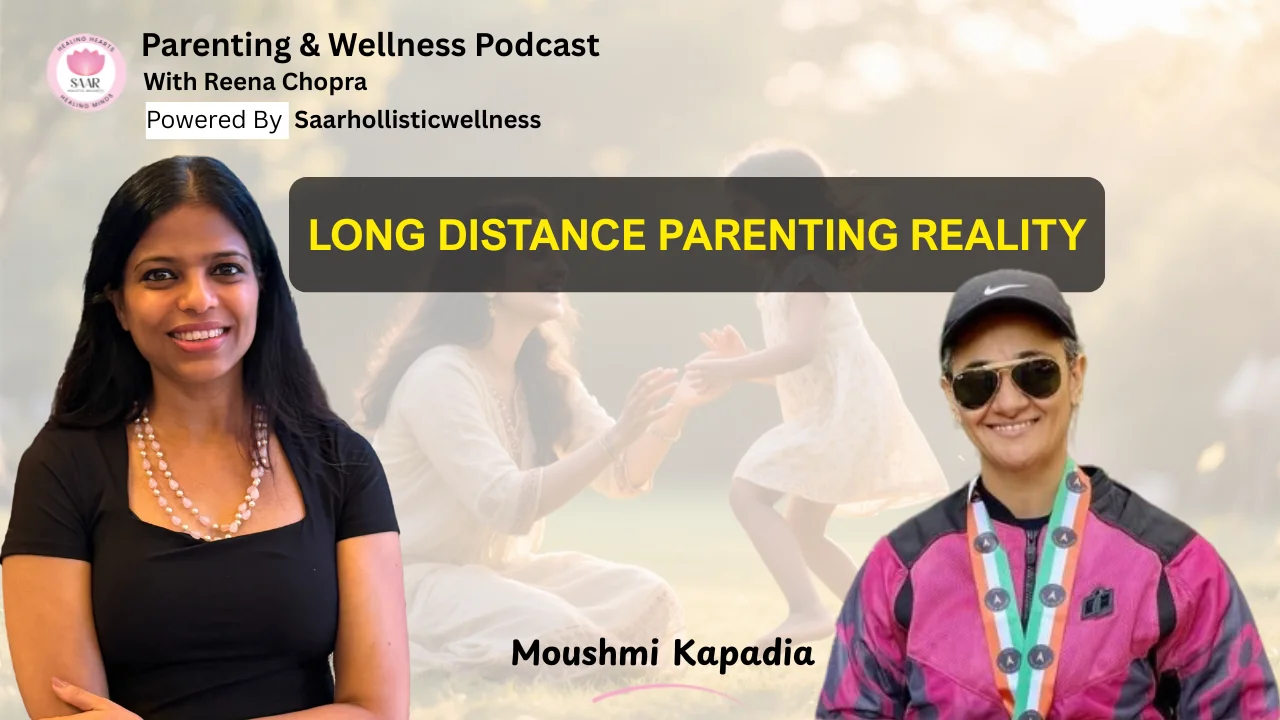
“Kaisi maa hai?” — a question soaked in judgment. When Moushami Kapadia, a biker mom and artist, chose mental health over martyrdom, society had opinions. But she had one mission: to be a calmer, more connected mother, even if it meant taking the road less traveled.
In a moving conversation with Psychologist Reena Chopra, she unpacks the emotional truth behind long-distance parenting.
The Invisible Weight of Mom Guilt
No matter how hard she worked, one question lingered — “Am I doing enough?”
For many Indian mothers balancing career and caregiving, guilt becomes a constant shadow. Moushami realized that guilt doesn’t make you a better mom — peace does.
“When I take care of myself, I come back to my child recharged and joyful — not resentful.”
What Self-Care Really Means
Self-care isn’t spa days or vacations — it’s mental hygiene. It’s taking time to breathe, cry, talk, and rest — so your energy doesn’t overflow as anger or fatigue.
Reena Chopra adds,
“Children learn emotional regulation from the energy their parents bring home, not from what they say.”
A mindful break helps both the parent and child heal.
When Distance Builds Strength
Distance doesn’t always weaken bonds — sometimes, it strengthens them. In Moushami’s case, being away for work made every call, hug, and visit intentional. She learned that connection isn’t about time — it’s about presence.
“Even when I’m away, my daughter knows I’m emotionally there,” she said.
Society’s Judgment vs. Inner Peace
Society labels working moms as “selfish,” stay-at-home moms as “lazy,” and single moms as “broken.” But the truth is, every mother is doing her best within her circumstances.
Long-distance parenting forces one to define motherhood beyond proximity — to love deeply without guilt.
How to Stay Emotionally Connected
💬 Daily check-ins: short voice notes or video calls.
💙 Rituals of connection: bedtime affirmations, shared journaling, or weekly letters.
🧘♀️ Emotional balance: therapy, mindfulness, or community support.
🌿 Honesty: telling your child why you’re away builds trust, not confusion.
Calm Mother, Calm Child
A mother’s calm becomes a child’s compass. When mothers stop equating exhaustion with love, they teach children that self-respect is part of care.
Reena Chopra beautifully puts it:
“You can’t pour from an empty cup — and children don’t need perfection, they need peace.”
Final Takeaway
Motherhood isn’t about constant presence — it’s about consistent love. When women choose to nurture their mental health, they raise emotionally secure, resilient children.
A calm mother isn’t selfish. She’s sacred. 🌸
Discover holistic parenting tools and emotional wellness programs at 👉 Saar Holistic Wellness
Reena Chopra, Founder of Saar Holistic Wellness, is an award-winning child psychologist with over 17 years of experience. She has worked with leading platforms such as UNICEF, EuroKids, Global Excellence Forum, NMIET, Curious Cubs, Lions Club, and TiE.
She is also a devoted mother who believes that calm mothers raise calm children and connected families. Her work focuses on emotional well-being, mindful parenting, and managing hyperactivity through practical psychology.
She is the author of the parenting e-book I Am Not Hyper, I Am Helpless, a guide that helps parents see hyperactive behavior as a struggle for support rather than defiance. Through her HyperKids Parenting Program, she gives parents practical tools to handle anger, routines, and daily challenges with more patience and understanding.
Her articles have been featured in ParentsWorld, Mumbai Times, ANI, Times of India, and MyCityLinks. She also hosts conversations with celebrities and experts on parenting across different life stages.
Psychologist Reena Chopra
Founder Saar Holistic Wellness
You might also like
Hyperactivity & ADHD
16 Oct 2026
Can a Child Outgrow ADHD? Teens and Adult Symptoms
Some children experience fewer ADHD symptoms as they grow older, but ADHD often continues into adolescence and adulthood. Symptoms may become less noticeable or change in how they affect everyday life. This does not necessarily mean the condition has disappeared. For example, a young child who constantly runs around the classroom may become a teenager […]
ADHD and Dyslexia: Why They Get Mixed Up in Children
Why do ADHD and dyslexia get mixed up? ADHD and dyslexia can be confused because both may affect a child’s school performance, reading activities, written work, and confidence. However, they affect learning in different ways. ADHD primarily affects attention regulation, impulse control, and activity levels, while dyslexia primarily affects accurate and fluent word reading and […]
My Teen Is Scared AI Will Take Their Job: How Parents Can Talk About Career Anxiety
“Should I still study computer science?” “Will doctors, writers, designers, accountants, or lawyers be replaced?” “What is the point of working hard if AI can do it faster?” These questions are increasingly appearing in Indian homes. For a teenager already carrying pressure about subjects, entrance exams, fees, college choices, and family expectations, AI can make […]