
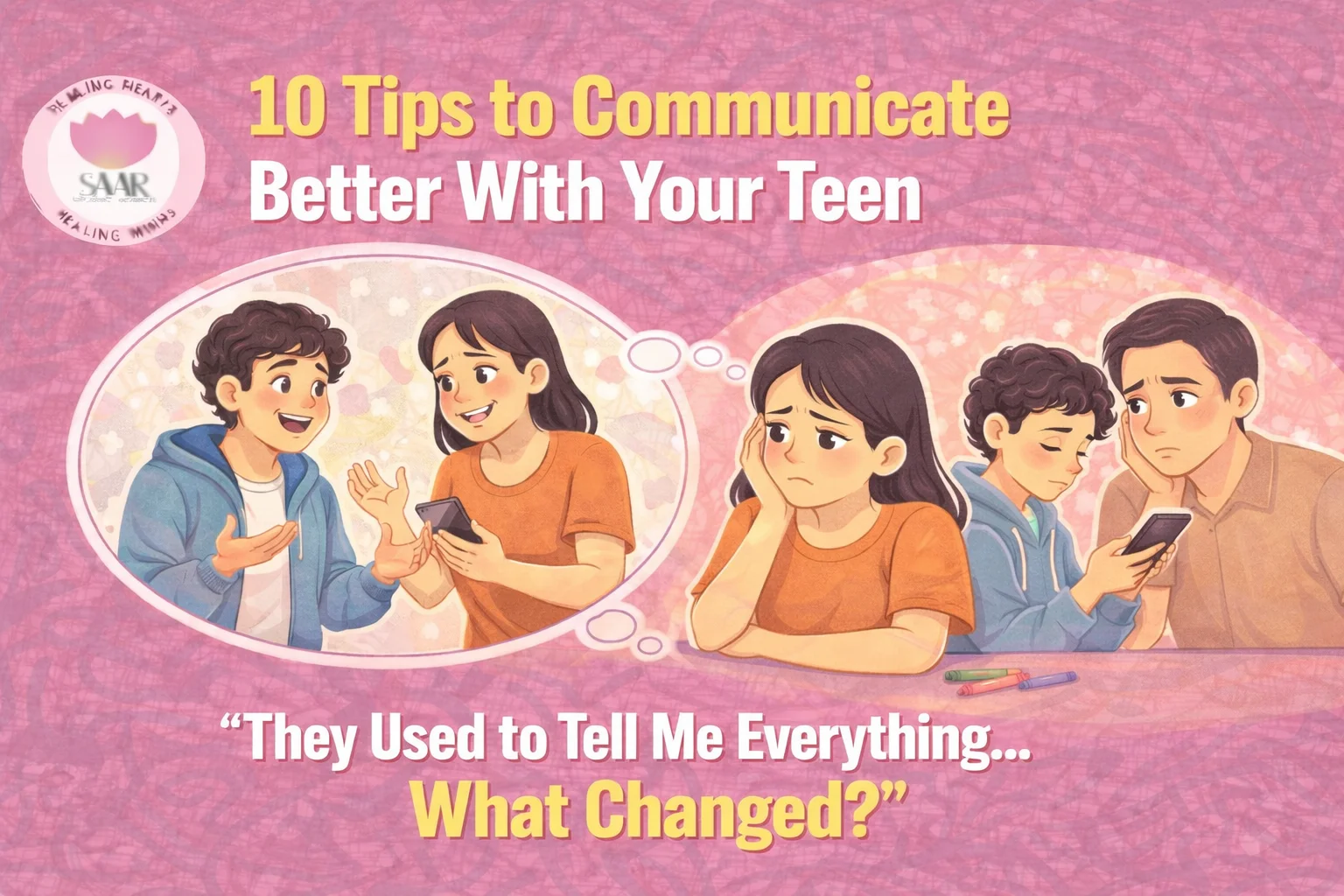
10 Tips to Communicate Better With Your Teen

April 15, 2026

Reena Chopra

10 Tips to Communicate Better With Your Teen

Share It!

They Used to Tell Me Everything… What Changed?”

There was a time when your child would share everything — school stories, small fights, random thoughts.

And now?

You ask, “How was your day?”
They say, “Fine.”

You try to talk…
They walk away, stay on their phone, or respond with silence.

As a parent, this can feel confusing, frustrating, even painful.

You start wondering:
👉 Why doesn’t my teen talk to me anymore?
👉 Am I doing something wrong?

The truth is communication with teens doesn’t stop.
It just changes form.

Why Communication Feels Hard During Teenage Years

Teenagers are:

  • Seeking independence
  • Becoming more self-aware
  • Emotionally sensitive
  • Easily misunderstood
  • Trying to figure out their identity

So when communication breaks, it’s not rejection it’s transition.

10 Practical Tips to Communicate Better With Your Teen

1️⃣ Listen More Than You Speak

Teens shut down when they feel lectured.

Instead of giving advice immediately, just listen.
Sometimes they don’t need solutions they need space.

2️⃣ Don’t Start With Judgement

If every conversation begins with correction, they will avoid talking.

Replace:
❌ “Why did you do that?”
With:
✅ “What happened?”

3️⃣ Choose the Right Time

Serious talks don’t work when your teen is:

  • Tired
  • Distracted
  • Already irritated

Casual moments (car rides, meals) often work better.

4️⃣ Respect Their Space

Teenagers need privacy.

Constant questioning feels like control.
Give space it builds trust.

5️⃣ Stay Calm Even When They’re Not

Teens may react emotionally. If you react the same way, it escalates.

Your calmness becomes their emotional anchor.

6️⃣ Don’t Turn Every Talk Into a Lesson

Not every conversation needs advice.

Sometimes saying “I understand” is enough.

7️⃣ Be Open About Your Own Feelings

Instead of blaming:
❌ “You never talk to me”
Try:
✅ “I miss talking to you”

This invites connection instead of resistance.

8️⃣ Avoid Comparing Them

Comparison shuts communication instantly.

Every teen wants to feel accepted, not measured.

9️⃣ Appreciate Small Conversations

Even a 2-minute talk matters.

Don’t dismiss small sharing it builds bigger trust.

🔟 Be Patient — Connection Takes Time

Teens may not open up immediately.

Consistency matters more than perfection.

A Note for Parents (Especially Mothers)

Many parents feel this silently:

  • “My child is drifting away from me”
  • “They don’t need me anymore”
  • “I don’t know how to reach them”

But your role is not ending it is evolving.

Your teen still needs you…
Just in a different way.

If communication with your teen feels:

  • Distant
  • Confusing
  • Emotionally draining
  • Full of arguments or silence

You don’t have to figure this out alone.

Our one-to-one parenting counselling sessions help parents:

  • Improve communication with teens
  • Handle emotional outbursts calmly
  • Build trust and connection
  • Understand teenage behavior deeply

👉 Book a session today and start rebuilding your connection.

A Gentle Reminder

Your teen is not pushing you away —
they are trying to find themselves.

And the way you communicate today
will shape your relationship for years to come.

i don’t want to yell
I Don't want to Yell
mindful parenting in tantrums
Mindful Parenting in Tantrums
balanced motherhood psychology for screen time
Balanced Motherhood Psychology for Screen Time
chatgpt image feb 28, 2026, 09 39 26 pm

Turn Your Child’s Energy Into Strength

Join the Hyperactive Kids Workshop

About the Author

Reena Chopra, Founder of Saar Holistic Wellness, is an award-winning child psychologist with over 17 years of experience. She has worked with leading platforms such as UNICEF, EuroKids, Global Excellence Forum, NMIET, Curious Cubs, Lions Club, and TiE.

She is also a devoted mother who believes that calm mothers raise calm children and connected families. Her work focuses on emotional well-being, mindful parenting, and managing hyperactivity through practical psychology.

She is the author of the parenting e-book I Am Not Hyper, I Am Helpless, a guide that helps parents see hyperactive behavior as a struggle for support rather than defiance. Through her HyperKids Parenting Program, she gives parents practical tools to handle anger, routines, and daily challenges with more patience and understanding.

Her articles have been featured in ParentsWorld, Mumbai Times, ANI, Times of India, and MyCityLinks. She also hosts conversations with celebrities and experts on parenting across different life stages.

reena chopra

Psychologist Reena Chopra

Founder Saar Holistic Wellness

You might also like

Hyperkids Parenting Workshop in Delhi

Hyperactivity & ADHD

25 Oct 2026

Hyperkids Parenting Workshop in Delhi | Reena Chopra

The Interactive Hyperkids Parenting Workshop is an in-person parenting session led by Reena Chopra, psychologist, mental health expert, and founder and CEO of Saar Holistic Wellness Pvt. Ltd. The workshop is intended for parents who want to understand their child’s behaviour beyond what they see on the surface. Rather than viewing every restless moment, interruption, […]
Can a Child Outgrow ADHD Teens and Adult Symptoms

Hyperactivity & ADHD

16 Oct 2026

Can a Child Outgrow ADHD? Teens and Adult Symptoms

Some children experience fewer ADHD symptoms as they grow older, but ADHD often continues into adolescence and adulthood. Symptoms may become less noticeable or change in how they affect everyday life. This does not necessarily mean the condition has disappeared. For example, a young child who constantly runs around the classroom may become a teenager […]
ADHD and Dyslexia Why They Get Mixed Up in Children

Hyperactivity & ADHD

16 Oct 2026

ADHD and Dyslexia: Why They Get Mixed Up in Children

Why do ADHD and dyslexia get mixed up? ADHD and dyslexia can be confused because both may affect a child’s school performance, reading activities, written work, and confidence. However, they affect learning in different ways. ADHD primarily affects attention regulation, impulse control, and activity levels, while dyslexia primarily affects accurate and fluent word reading and […]