
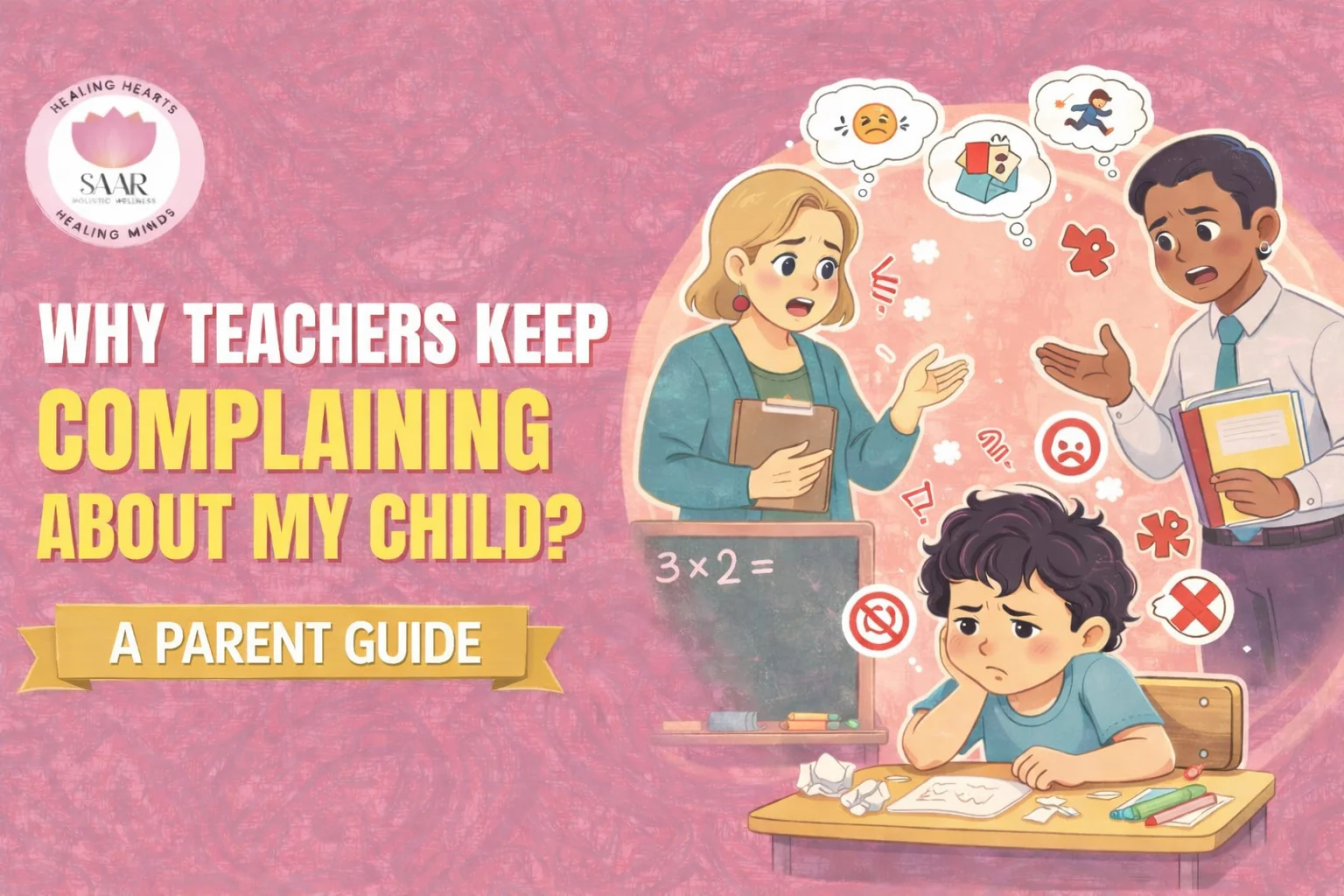
When It Feels Like Your Child Is Always in Trouble
Some parents hear complaints once in a while.
But some parents hear the same things again and again:
- “Your child doesn’t sit in class.”
- “Your child talks too much.”
- “Your child disturbs other students.”
- “Your child doesn’t complete work.”
- “Your child doesn’t listen.”
After a point, it stops feeling like a complaint about behavior — it starts feeling like a complaint about your child… and about your parenting.
You start feeling embarrassed in PTMs, worried at home, and confused about what to do next.
But before blaming your child or yourself, let’s understand something important.
What Teachers Really Mean When They Complain
Teachers usually complain when a child struggles with:
- Sitting for long periods
- Paying attention
- Following instructions
- Waiting for their turn
- Controlling impulses
- Managing emotions
- Staying quiet in class
These are not just “discipline” issues.
These are self-regulation skills and some children take longer to develop them.
So when teachers complain repeatedly, it often means:
👉 Your child is struggling, not trying to trouble the teacher.
A Special Section for Mothers
Let’s talk about what usually happens at home.
When teachers complain, family members often say:
- “You don’t control him.”
- “You’re too soft.”
- “You don’t know how to handle your child.”
- “In our time, children were scared of parents.”
And somehow, all the blame comes to the mother.
But what people don’t see is:
- You handling morning rush
- You managing homework
- You handling tantrums
- You talking to teachers
- You worrying at night
- You feeling guilty even when you tried your best
So if teachers keep complaining about your child, please remember:
👉 This is not just a discipline issue.
👉 This is a behavior understanding issue — and you need strategy, not blame.
What Parents Can Do When Teachers Keep Complaining
1️⃣ Ask for Specific Situations
Instead of “He is very naughty,” ask:
- When does this happen?
- During which subject?
- During sitting, writing, or group activity?
Details help find solutions.
2️⃣ Don’t Only Scold Your Child
If the child is already struggling, scolding increases fear and reduces confidence.
3️⃣ Teach Skills at Home
Focus on:
- Sitting for short periods
- Listening to instructions
- Waiting for turn
- Expressing anger in words
These are skills and skills can be taught.
3️⃣ Teach Skills at Home
Focus on:
- Sitting for short periods
- Listening to instructions
- Waiting for turn
- Expressing anger in words
These are skills — and skills can be taught.
4️⃣ Work With Teachers as a Team
When parents and teachers work together, children improve faster.
If teacher complaints are becoming regular and stressful, you don’t have to handle this alone.
Our one-to-one parenting counselling sessions help parents:
- Understand why teachers complain
- Learn behavior and listening strategies
- Help children with attention and emotional control
- Reduce school complaints
- Reduce stress at home
👉 Book a session today because sometimes, parents need the right guidance, not more blame.
A Gentle Reminder
Your child is not a “problem child.”
Your child may be a child with a problem — and problems can be solved with the right support.
And you are not a bad parent.
You are a worried parent who is trying every day.


